Sunday, 11 November 2012

The Heroes in my Family


On this day of remembrance I felt it was only appropriate to write a few words about my hero ancestors. My family is not unique. Like everyone who delves into their ancestry I have found many family members who went off to fight for their country, to 'do their bit'. Some made the ultimate sacrifice and were laid to rest where they died; some don't have a final resting place; all live on through stone memorials. Others were fortunate enough to make it through their war and return to homes and families. They may not have returned unscathed, either mentally or physically, but return they did. They aren't marked on a memorial but, like their fallen brethren, they are remembered. To me, they are all heroes.

Charles Stracey 1894-1917
My great uncle Charles was 22 years old when he died in France on 17th February 1917. A private in the 6th Battalion, Princess Charlotte of Wales (Royal Berkshire) Regiment, it's probable that he died during the action taken at Miraumont to capture several German trenches. During the early hours of the 17th February, as the troops assembled in preparation to go over the top, the Germans heavily barraged the assembly areas. Most of the day's casualties happened as a result of this barrage and I believe, as Charles' body was never recovered, that it was at this point that he died. His name is recorded on the great Thiepval Memorial to the missing in northern France.

Samuel Ezekiel Hardwick
Samuel Ezekiel Hardwick 1881-1917
Sam Hardwick, my great grand uncle, died of wounds on 7th April 1917. He was a private in the 8th Battalion, Queen's (Royal West Surrey) Regiment. I've been unable to work out where or when he was injured but I find it quite distressing to think that he may have suffered dreadfully in a casualty clearing station before finally succumbing to his wounds. He is buried in Calais Southern Cemetery (which I'm glad to have visited in 2010 to lay some flowers on his grave) and left behind a wife and seven year old daughter.

James Ivanhoe Cullip 1894-1918
James is an ancestor that I've written about before. One of my great uncles, he served as a gunner in the Royal Garrison Artillery, one of the men employed to pound the German lines with their big guns. He survived the war but tragically died two weeks before the armistice, and just one week after getting married, as a result of the Spanish Flu pandemic.

Thomas William Cullip 1899-1964
Great Uncle Thomas had been 18 years old for just two weeks when he enlisted in the Royal Navy in 1917. After training on HMS Pembroke he became a member of the crew of HMS Juno in March. He served on Juno until he was demobbed in April 1919.

Albert Edward Cannon (born Cullip) Born 1897
My first cousin twice removed, Albert Cannon, enlisted aged 19 in the Royal Garrison Artillery in 1915. Luckily for me, his is one of the few surviving service records which gives a wealth of information about his time in service. He survived the war and even volunteered for the Army of Occupation in 1919. After demobilisation in 1920 he sailed to Canada where he married and created a new life away from a war weary Europe.

Albert Stracey 1883-1945
My great uncle Albert also survived the war but suffered for the rest of his life from the effects of shell shock. He enlisted into the Royal Berkshires in 1915 at the age of 32. However, just 18 months later he was discharged from service under Paragraph 392 of King's Regulations 1912. He was deemed no longer physically fit for war service and issued with the Silver War Badge. My father remembers how Albert would sit in his chair and physically shake, an affliction he suffered with for the rest of his life.

Nathaniel Joe Stracey
Nathaniel Joe Stracey 1891-1961
My grandfather is another person I've written about previously. He served in the 5th Battalion, East Kent Regiment, the 'Buffs', in Mesopotamia and India. He survived the war unscathed.

John Stracey 1885-1949
I believe my great uncle John may have been one of the Old Contemptibles. Before the war he was a soldier in the regular army, serving as a private in the 1st Bedfordshire Regiment and his medal record shows that he qualified for medals from the 16th August 1914 - he was in it from the start! He may have fought at such major battles as Mons, Ypres and the Somme. Incredibly, he survived the whole four years of war.
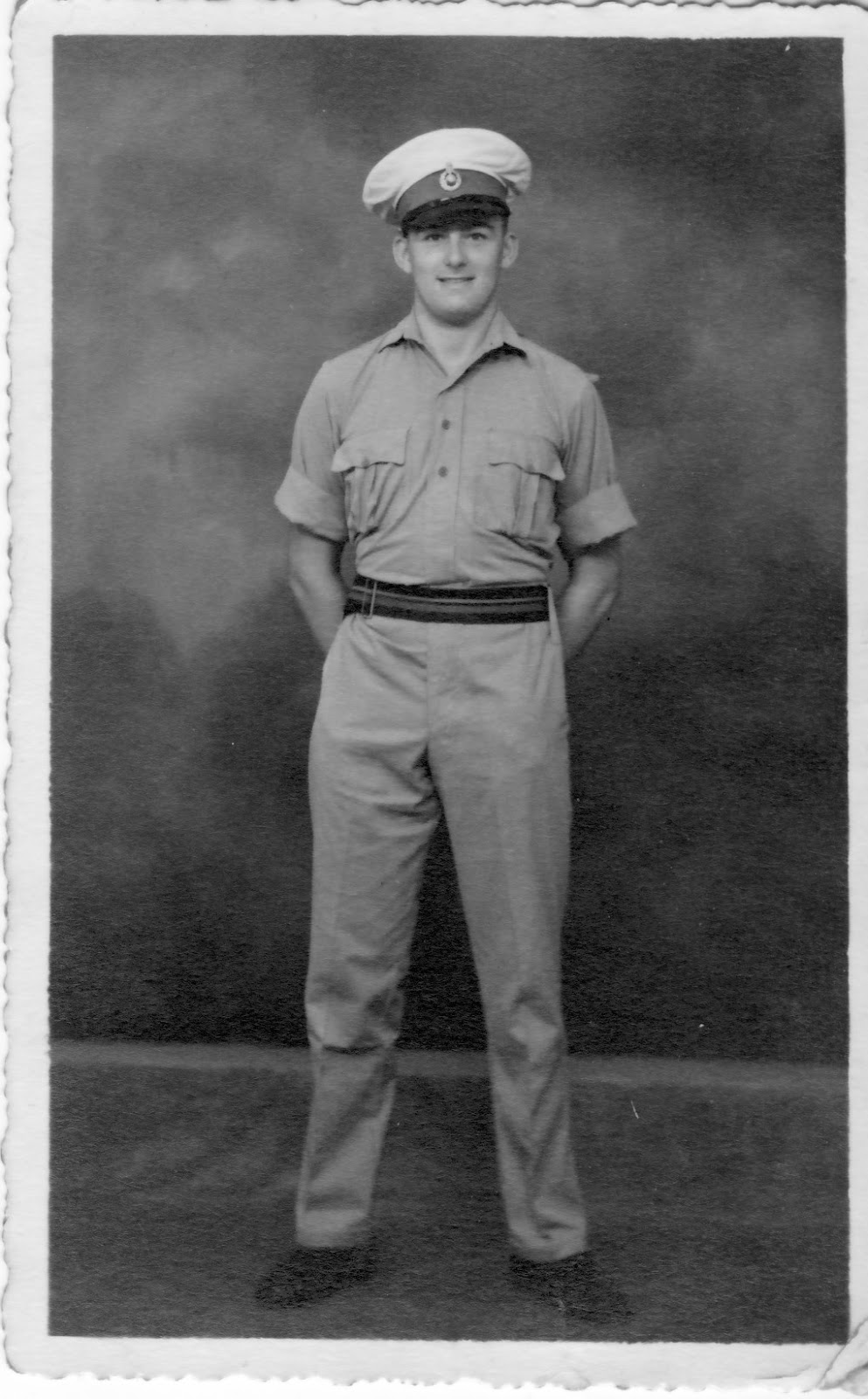
Joseph Roy Stracey
Joseph Roy Stracey 1922-1942
I've written quite a lot about my uncle Roy so please see my previous post for an account of his brief life and death. Roy was a royal marine serving on HMS Hermes when it was attacked and sunk by Japanese fighter planes on 22nd April 1942. He was only 19 when he died and his name is recorded on the Plymouth Naval Memorial.


At the going down of the sun and in the morning,
We will remember them.

Thursday, 1 November 2012

Birthplace conundrums

I'm always quite intrigued about the town or village that my ancestors put down as their birthplace. Sometimes it's straightforward: they were born, married and died in the same place so there is no deviation in the place of birth that they gave to the census enumerator. Other times it changes from census to census but its usually in the correct vicinity. Did they not know where they were born? Or was it a case of there being more than one obvious option. For instance, I was born in Bushey in Hertfordshire, yet I quite often say I was born in Watford. This is because Bushey is practically on Watford's doorstep, you can't really tell where one stops and the other begins and also because people are more likely to have heard of Watford.

Today I have been working on the life of my first cousin four times removed, Elizabeth Cullip. I had a bit of trouble searching for her records simply because of the birthplace she'd put down. I developed doubts as to whether I'd got the correct person in the census. But with a bit of lateral thinking I believe I've worked out her way of thinking and the explanation behind the varying places of birth.

Elizabeth was born in 1818 in the village of Eaton Socon in Bedfordshire. Her mother Sarah came from Boxworth which lies about 15 miles to the east in neighbouring Cambridgeshire. Her father Thomas came from Tempsford in Bedfordshire which is about six miles south of Eaton Socon. How Thomas met Sarah I don't know, but the wedding took place in Sarah's home parish of Boxworth. And how they ended up in Eaton Socon is also unknown but this is where Elizabeth was born two years later.

Sadly, Thomas died in 1819 just a year after Elizabeth was born. He was only 24 and was buried in his birth village of Tempsford. And it's at this point I had to put my lateral thinking hat on as the census records weren't telling me what I expected them to.

Elizabeth married a fellow called Robert Ward in 1838 in Boxworth. Interesting, I thought, she's married someone from her mother's home village. But why does she indicate on the 1841, 1851 and 1861 census returns that she was actually born there when she wasn't? Yes, she was living in Boxworth (she lived there until she died in 1888) and her husband was born in Boxworth, as were their four children. The census enumerator could have made a mistake, but could the same mistake occur for three decades in a row. My theory is that when her mother was widowed at such a young age, she returned to the shelter and protection of her own family in Boxworth where she raised her daughter from the age of one. Elizabeth would have been brought up thinking of Boxworth as her home village. Being the only place she'd ever known, it's clear she considered the village as the place she was actually born. And if no one put her right then Boxworth is what she would tell the census enumerators.

Things took a curious turn however on the 1871 and 1881 census records. On those she recorded her birthplace as Tempsford. So for once she'd got the correct county, but she'd still not got the right village. Perhaps by this stage she was aware that Boxworth was not her village of birth but there was clearly still no mention of Eaton Socon as the place she was actually born. It's as if this fact had been forgotten in the family for years. Instead she opted for the place where her father came from and put down Tempsford. I guess for her it was logical: she was born in Bedfordshire so it must be where her father was born.

As you can see this is all supposition, but in the absence of hard facts and without the ability to actually sit down with the person in question and quiz them about their reasons, one has to turn to supposition to come up with a logical theory. In this case guesswork is all I have but it helps when deciphering census records that thrown in sudden curve balls!

Sunday, 21 October 2012

The Mother Worse than the Son

I absolutely loved finding this small snippet during a perusal of the British Newspaper Archive the other week. On a search for any newspaper articles about my grandmother's family, the Antcliffes, I found this article from the Derbyshire Times and Chesterfield Herald, dated 7 November 1894.

It was the title of the piece that caught my eye: "The Mother Worse than the Son". Goodness, whatever did this mother and son combo do to warrant such a headline? Well, the son, my Great Grand Uncle Fred, stole a duck! And my 2 x Great Grandmother Harriet dared to keep the duck, skin it and eat it. Dreadful stuff. She even burnt the evidence which I guess reveals that she knew she was doing wrong by accepting the offending bird from Fred in the first place.

The Antcliffes are a family that are gradually revealing their secrets to me and this article has helped to put some flesh on the bones. Knowing this one small event from their lives means I now look upon Fred and Harriet, two people I had no previous clue about, with fondness and certainly not with any disapproval for their actions. I mean, if a tasty duck came your way, and you had six children to feed, would you turn it down?

I took great pleasure in telling one of my aunts that she had 'criminal' ancestors. She was very quick to respond with the fact that I therefore had criminal ancestors too!


Sunday, 23 September 2012

Founders and Survivors

Thanks to Twitter yesterday I came across what I believe will be an invaluable website to anyone tracing their convict ancestors who were transported to Tasmania.

Founders and Survivors aims, and I quote here from the website, "to record and study the founding population of 73,000 men, women and children who were transported to Tasmania. Many survived their convict experience and went on to help build a new society".

The website would like family historians to input known details of their convict ancestors, families and descendants on to the database and is also after volunteers for the, as far as I'm concerned, very enviable job of going through the original records to find out what happened to the convicts once they'd left the system.

Having a convict ancestor myself, my three times great grandfather Joseph Cullip, albeit one who managed to return to England after serving his time, I was keen to see whether he was listed on their database. He is! Which I was overjoyed to see. And I'll be sure to add some more details to the record that exists for him. I searched for him by simply inputting his surname, and was amazed to come across two more people who shared derivatives of the Cullip surname, one of whom is a very likely candidate for being an ancestor of mine. He comes from the right part of Bedfordshire so I'll be conducting some further investigation into him and I have my fingers crossed that we're related.

This very interesting newspaper article from The Age gives further information on the project.

I'd highly recommend everyone with a convict ancestor who ended up in Tasmania to check this website out. I suspect it's going to prove incredibly important for all family historians.

Sunday, 9 September 2012

Great Aunts and Uncles

My dad had lots of aunts and uncles on his mother's side. I don't think I realised quite how how many until I started investigating my family tree. As a child I remember visiting only one of them on several occasions. And that was my dad's Auntie Dot. We'd bundle into the car, drive up to her house and have tea in what my memory recalls as a tiny front room. I never looked forward to going; I wanted to stay behind and play with my toys. But I remember ultimately I always enjoyed those visits as Auntie Dot, or should I say my Great Auntie Dot, was a lovely person. I lament those lost opportunities to have talked to her about her life and the life of her siblings; of growing up in East Finchley, north London; living through the First World War; marriage; children; enduring the bombings of the Second World War; the birth of grandchildren. And, of course, she is now long gone, along with all her brothers and sisters. So this is my small tribute to them, to the relatives that I would give my eye teeth to talk to now. Unfortunately I know very little about any of them, but I think in many cases, the photos tell their story...

My grandmother, Esther May, was the eldest of the siblings, born in 1892 to James Cullip and Ann Esther Hardwick who came from Tempsford in Bedfordshire. By the time of Esther May's birth, the couple had relocated to East Finchley where all their children were born. I'm not going to go into any detail now about my grandmother as I will most definitely be posting a full blog on her in the future.

She was followed two years later by James Ivanhoe. I've already written at length about James. He tragically died at the close of World World One, just one week after he got married, after contracting the Spanish Flu virus. No photos have survived of him, however I do have a very poignant card that he sent to my grandmother Esther May. He must have sent it to her when he was serving in France as the card has been hand-made using a French post-card as the backing with a delicately embroidered image pasted on the front. The wording on the back simply states, 'with fondest love from Jim'.

The postcard that James sent to his sister, Esther May,
during World War One.

Mabel Elizabeth, known to everyone as Lizzie, was the third born, entering this world in 1897. She married a chap called Len Stevens and had three children by him. Most of the siblings lived to a good age, but Lizzie, along with her brother James, was the exception to the rule and sadly died in 1940 at the young age of 43.

This lovely photo shows a very happy family gathering. Lizzie is the lady on the far right. Her husband Len is resting his hand on her shoulder. I believe she is pregnant in that photo with her son Robert. My grandmother, the lady in white, also looks rather pregnant, which would mean this photo would have been taken in 1932. She is carrying my dad!

From left to right, my great uncle Tom Cullip and his wife Dora, my grandmother
Esther May, my grandfather Nathaniel Joe, my great aunt Lizzie, her husband Len.
The two boys are Tom and Dora's son, James, and my uncle Roy.

The fourth child to join the family was the second and last son, Thomas. During the First World War Thomas enlisted in the navy where he served on board HMS Juno. Luckily he survived the war unscathed and two years after his demobilisation he married Dorothy Bowen, otherwise known as Dora. They had one son, James. They are pictured in the photo above on the left hand side. He died in 1964.

And then lots of girls were born! The fifth child was Ethel Alice, born in 1901. She was known as Alice and married quite late in life at the age of 50. Her husband, Cecil Humby, was seven years her senior and a widower. He already had a daughter by his first marriage. They were to be married for 16 years as Cecil passed away in 1967 leaving Alice a widow for the next 18 years, until she too died in 1985. This photo shows Alice and Cecil on their wedding day. He looks very dapper in his suit with beautifully pressed trousers!

Alice Cullip and Cecil Humby's wedding day

Child number six was my Great Auntie Dot, who was baptised as Dorothy Mary. She married Ernest Bishop at the age of 24, had two children and lived to the ripe old age of 94. As I said earlier, she's the only aunt I have any semblance of a memory of. My childhood recollections are of a very warm and gentle woman. And of teas in front of her gas fire...

The next child to join the clan was born in 1906, Florence Winifred, known as Win. Win married Arthur Miller and had two children. She died in 1991 aged 85.

Win, wearing white

The penultimate child was Elsie Irene. She married Reginald Terry in 1934 but I've been unable to find any children for them. I have a wonderful photo, definitely one of my favourites, which shows Elsie with a 'trying not to laugh at the camera' expression on her face. She's failing dismally. She's seated on the ground, with her sister Win, in front of four elderly ladies, one of whom has the most fantastic outfit on. The ladies dressed in black look fairly stern, whereas Elsie can't seem to stop laughing. I would love to have known what the occasion was. I think I would have liked Elsie if I had got to know her. She died in 1999, aged 90.

Four stern old ladies, with sisters Win (left) and Elsie (right).

The last child and the baby of the pack, born in 1912, was Edith, known as Edie. She married William Boulton when she was 22 and had three children. She was a fairly well built and bespectacled young lady but  in every photo that I have of her she wears a wide beaming smile. As befits the youngest of the family she was the last surviving sibling and the only one to see in the new millennium. She died in 2004.

Edie holding a handsome young chap, my dad.

So I only really have the bare bones of facts for most of my great aunts and uncles. But I have a lot of photos and I feel that these images really reveal the inner souls and personalities of the people portrayed. They show siblings who got on well and clearly have a great affection for each other. There appear to have been numerous occasions when the family got together to celebrate births and marriages, or for day trips to the seaside, or just to gather for the sake of it.

Which brings me on to the last photo. This wonderful image is the only one I own which shows all the surviving siblings in one picture. I would guess that it was taken in the first years of the 1960s. My grandmother, who died in 1969, looks fairly elderly and frail and as her brother Tom, who is standing next to her, died in 1964, I feel this photo was probably taken around 1962. But that's just a guess. I love this photo for the fact that the ladies all look so smart with their pale coloured hats, white gloves and handbags. As most of them are wearing pigeon holes, they must have been attending a family wedding, but whose I don't know. It was probably one of the last photos taken of all the siblings together. It's a shame that both Lizzie and James were not alive to feature in it, but seven out of nine isn't bad!

From left to right, Edie, Elsie, Win, Dot, Alice, Tom, May.

Sunday, 12 August 2012

The Aunt I Never Knew

This is a blog post about asking the right questions. As a child I always knew my dad had a sister who had died long before I was born, but for years I knew almost nothing about her, she was just a name. It wasn't that Gladys was a black sheep in the family which meant she shouldn't be mentioned, it was more the case that my dad never spoke about any of his family. Or rather he never volunteered the information though he would happily talk about them if you asked. When I was young, and not interested in my ancestry, I didn't have the right questions in mind so never expanded my knowledge of what Gladys was like. It's only since I began investigating my family tree, using a combination of the available records, and pinning my father down to ask those all important questions, that I've managed to piece together Gladys' short life and put some flesh on the bones.

Gladys c.1920

Gladys was born on 14th July 1916 in East Finchley in North London, the first child of Joe and May Stracey. The world was embroiled in the Great War and so for the first few years of her life she would see little of her father who was away serving his country in Mesopotamia and India. For the duration of the war, Joe would carry a small photo of Gladys and her mother in his wallet.

Gladys and her mother - the photo
that Joe carried in his wallet
When she was six, Gladys was joined by a younger brother, Roy, and then ten years later my father completed the family. I know very little about her early years, however judging from the wonderful family photo albums that I have, it was a happy time, full of games, family occasions and childhood scraps.

From this point onward until her death, her life was a blank. I knew she had died at a fairly young age but my dad was not forthcoming with the cause. It was time to delve deeper and start asking questions.

So on a visit to my dad a couple of years ago, we were talking about family history and I casually asked him whether she had ever been married, expecting the answer to be in the negative as there had never been any mention of a husband or children. "Oh yes", replied my dad, "she married a POW". I was quite dumbfounded. After several years of researching my family tree and interrogating my father about his family and Gladys, he had never mentioned that his sister had been married. I don't blame him however, after all, I hadn't asked the pertinent question!

Samuel and Gladys McNairney
It turns out that Gladys had married a gentleman by the name of Samuel James Woods McNairney, in London, in 1951. He was, indeed, an ex-prisoner of war. Ancestry's British Army Prisoners of War dataset revealed that he had spent most of the war in a POW camp in Poland called Stalag XX-B. Further research on the internet explained how his battalion in the Royal Scots Fusiliers had been fighting a rearguard action during May 1940 to ensure the safe evacuation of troops at Dunkirk and that subsequently he had been captured. Gladys met him after the war when she was working as a cashier in a butcher's shop in Golders Green. My dad didn't particularly like him very much, describing him as "not a very nice man". That makes me feel quite sad as it has somewhat tainted my view of Samuel. I asked my father whether they had had children. I think I already knew the answer to that one, but it couldn't hurt to ask. "Oh no" replied my dad "she was much too old". She was 35 on her wedding day!

Gladys
Samuel wasn't Gladys' first love however. At some stage, most likely in the late 1930s, she met a young man called Donald Gabriel. He was a constable and they met one day on the East End Road in East Finchley. By all accounts he was her first serious relationship as they were engaged for a time. However, for reasons unknown, she broke off their engagement. Donald was a former pupil of the renowned Haberdasher Aske's Boys School in Hertfordshire and went on to join the army at the outbreak of the Second World War. Sadly he was not to survive. Dad thought he was in the Grenadier Guards and that he'd died in Burma but the only Donald Gabriel that I have found, via the Commonwealth War Graves Commission, is a Lieutenant in the Royal Indian Army Service Corp who died in 1943 and is buried in Baghdad. Donald and Gladys' relationship is the sort of information that would be almost impossible to find anywhere except through the recollections of a family member. Their romance would have been lost forever if my father had not recounted it to me.

But back to her marriage. Gladys and Samuel set up home in East Finchley just around the corner from the house in which she grew up. Sadly, however, they were only to be married for about eight years as in February 1959 Samuel died. Gladys moved back to live with her parents and brother although widowhood was to last just a few months. Later that same year, in early November, just months after the death of her husband, tragedy struck. Gladys had walked a fair distance from the local tube to her home and apparently walked into the house, sat at the kitchen table and had a massive heart attack. Her death certificate shows she had congestive heart disease and hypertension. But I was shocked when I noticed the date of her death. She had died on the 5th November on my father's 27th birthday.

Learning about Gladys has made me realise that it's the little details which can really make a person's history come to life. And these details so often come from a relative rather than an official document. They can also be found in newspapers, especially the splendidly written articles from the 19th century which never shied away from telling it how it was, full of juicy detail and commentary. But nothing beats the titbits you get from a relative as you then find out what they thought of the situation, or the person. That can only add flavour to an account of someone's life. So don't hesitate, quiz those relatives now, don't leave it until it's too late.

Gladys Stracey 1916-1959

Thursday, 2 August 2012

Mary Ann Matilda Ball 1848-1931

This is an account of another ordinary life, albeit one full of births, deaths and marriages. Mary Ann Matilda Ball is my paternal Great Great Grandmother. She lived to a good age, and although she seemed to have suffered more than her fair share of personal tragedy, I get an impression of a strong, persevering woman who, when necessary, stepped up to the plate and took on the responsibilities necessary to survive.

The Ripened Wheat by Jules Bastien-Lepage,
courtesy Wikigallery.org
Mary Ann was born in 1848, the year that revolution swept across Europe. However, the uprisings and social upheaval were a world away from Girtford, the small agricultural hamlet in Bedfordshire where Mary Ann was born. The hamlet lay on the Great North Road about two miles south of Tempsford where she was to spend all of her adult life. Her father, Edward, was an agricultural labourer. Her mother, Matilda, was to provide Mary Ann with her middle name.

By the time Mary Ann was recorded on her first census in 1851, the Ball family was complete. Mary Ann was the youngest child and, together with her two elder sisters, Fanny and Ellen, the family lived together in Girtford village. Their peaceful existence was not to last however as, in 1853, when Mary Ann was just two, Edward died at the young age of 28. His widow, Matilda, made a living from lace-making, a traditional livelihood in Bedfordshire, and supported her three young daughters single handed for the next ten years until she married for a second time in 1863. I believe that Mary Ann learned a lot from her mother about how to cope in times of adversity. She would have witnessed her mother's strength and I suspect this had a profound effect on Mary Ann's character and her own ability to strive through traumatic events.

Inside a Bakery by Gustaf Olaf Cederstrom, courtesy Wikigallery.org
At the age of 19 Mary Ann married a young baker from Tempsford, Samuel Hardwick. Together they lived in Langford End in Tempsford and raised four children, my great grandmother Ann, Fanny, Ellen and finally young Sam. Tragedy struck again however. When Sam was just a few months old, in June 1880, Samuel died of an epileptic fit. He was 33 years old. And this is when Mary Ann must have looked back and remembered her mother's resilience and incredible spirit, for she took over the family business and ran the bakery in the village. She was assisted by a journeyman baker, Henry Thompson, and her eldest daughter, my great-grandmother, Ann, who was only a child at the time. It was discovering that Mary Ann took on the bakery that made me develop a great admiration for her. She had a young family, including a tiny baby, and even though she probably had little choice but to take on the business, I still applaud her 'keep calm and carry on' attitude.

In 1885, Mary Ann married again. John Randall was a local man who worked as a general labourer. He had been born and bred in Tempsford, and the couple settled down to married life in the village that had been her home for the last 18 years. Mary Ann's propensity to give birth to girls continued with the birth of Alice, Florence and Winifred Mary.

Samuel Hardwick, died 1917
However, life was to deliver some harsh blows to Mary Ann, particularly in relation to her children. In 1882, two years after the death of her first husband and whilst still a young widow, her second born child Fanny died at the age of eleven. If that wasn't bad enough, eight years later, Mary Ann and John Randall's eldest, Alice, died of tubercular meningitis. She was 13 years old. And then came the war. Mary Ann's only son, Sam, was serving with the Royal West Surrey Regiment in France in 1917 when he was mortally wounded and later died of his wounds. Mary Ann outlived three of her children, a not un-common feature of life in the 19th and early 20th centuries. But it must have been devastating to lose two daughters to illness and then her only son in such a violent manner.

Mary Ann and John lived together in Tempsford until his death in 1928. She outlived him by three years and died at the ripe old age of 82.

Mary Ann, for me, is one of those ancestors that I just took to straight away. I admire how she stepped into her husband's flour-covered apron and made a living for herself and her family. Her's wasn't an easy life, it was marred by too much tragedy, but she survived, picked up the pieces and carried on. And because of that, she'll always be one of my heroes.