Showing posts with label gaol. Show all posts

Sunday, 1 February 2015

Just your typical genealogical puzzle

I do like a good challenge. Last week I revisited the family tree of my 3 x Great Grand Uncle, George Cullip, who was born in Bedfordshire in 1802. I had done some brief work on his family a few years back so it was time to refresh my memory, confirm facts and double check all the sources.

I started with the 1841 census. This stated that George was living in Leeds with his wife Lucy and children Joseph (born, according to the census, in 1826), Cornelius (b.1831), Betsey (b.1836) and Mary Ann (b.1838). If I could find the children's baptism dates I would get a truer indication of when the children were born. I had previously discovered that when George married Lucy he was a widower. His first wife, Mary Ibbott, had died in Tempsford, Bedfordshire in January 1833. He subsequently married Lucy Stonebridge in 1837, again in Tempsford. I therefore decided to search for the baptism records in Tempsford for Mary and George's children. The Bedfordshire parish records are not yet online, so I turned my attention to familysearch.org. This opened up an unexpected can of worms which tested my powers of investigation no end.


The Leeds 1841 census showing the children of George and Lucy Cullip.
The five year old Betsey triggered much investigation, assumption and a speculative conclusion.
George is resident with the family but features on the previous page.

I ran a 'parent search' looking for the children of George Cullip and Mary. To my surprise, there were six results, rather than the expected three (Mary Ann being the daughter of Lucy):

John, baptised Oct 1822
Joseph and Elizabeth, baptised Oct 1828
Cornelius, baptised May 1830
James and Alice, baptised Jan 1833

My first conundrum was where were James and Alice? They weren't on the 1841 census living with George and Lucy. The date of their baptism was 27 January 1833, just four days after their mother Mary had been buried. I came to the sad conclusion that she must have died as a result of childbirth. But had they too followed Mary to the grave? I can only conclude that that is what happened as I have been unable to locate them on any further census records. And unfortunately definitive death records are proving elusive too.

Secondly, I was intrigued by the birth of John in 1822. As he wasn't living with his parents by the time of the 1841 census he had slipped through my radar. In my earlier investigations into George, I had found a gaol record for him on the excellent Bedfordshire Gaol Register website. George had been committed in August 1822 to three months hard labour for refusing to obey a bastardy order. He was actually serving his sentence at the time of John's baptism in October. My theory is that George initially refused to admit to being John's father and perhaps after contact with his son he relented as, a year later, in December 1823, he and Mary were married. Whether this marriage was born out of love or duty is a matter of conjecture. It was five years before they had any surviving offspring so was the marriage initially strained? Of course, it may be that John's mother was a different Mary as the name was so common in the 19th century, but I like to think it is the same woman. My next task is to try and get my hands on the bastardy order, hopefully that will resolve the issue.

My final puzzle related to Elizabeth Cullip, I had initially noted down that she was born in 1836 as per the 1841 census. But this couldn't be the case if her baptism was in 1828! Why would a 13-year girl be listed as being five? Plus if she was Joseph's twin (an assumption brought about by the fact that they were baptised on the same day) then why isn't she noted as being the same age as him? By the 1851 census Elizabeth is listed as being 18 years old, indicating she was born in 1833 - yet another difference in her year of birth. It was at this point that a light bulb switched on over my head and I wondered whether in fact there were two different children. On the 1841 census the child is called Betsey, a common pet name for Elizabeth, hence my initial confusion. So I returned to familysearch and hunted for any Betsy or Betsey, rather than Elizabeth, born around 1833 in Tempsford. There at the top of the list was 'Betsy Stonebridge or Hare', baptised July 1832, daughter of Lucy Stonebridge and James Hare. The indecision regarding her surname led me to conclude that she must have been illegitimate. I had found my girl.

A subsequent search of the National Burial Index revealed an Elizabeth Cullip who died aged seven in 1833 and was buried in the February. There were indeed two children, one of whom switched between her birth name of Betsy and Elizabeth throughout her life, causing future amateur genealogists some trouble! I can only assume that the enumerator made an error on the 1841 census by rounding her age down from eight to five.

As Elizabeth Cullip's death followed so soon after the death of her mother I wonder whether Mary didn't in fact die in childbirth but had succombed to an illness which she then passed on to her daughter. We will probably never know.
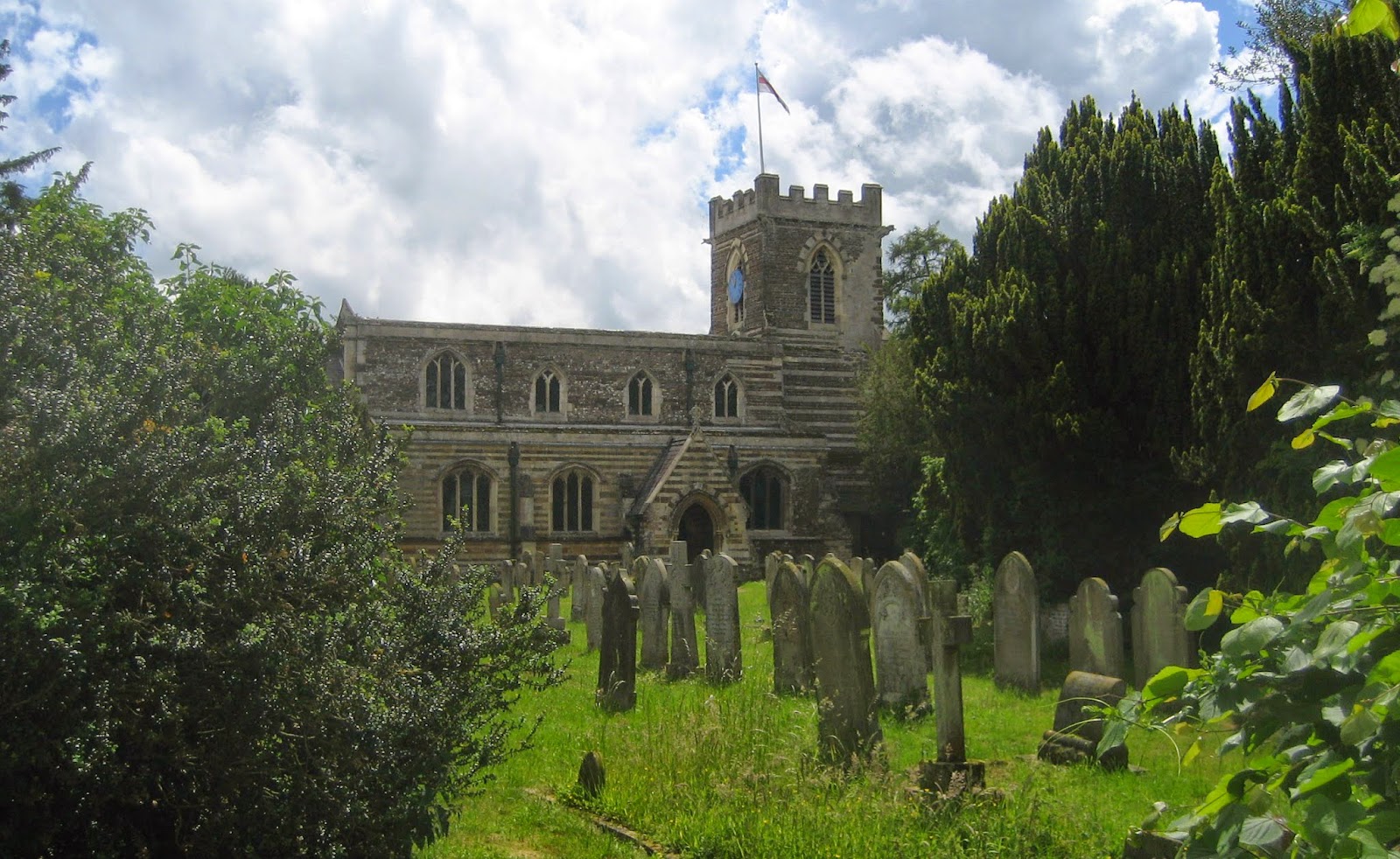
Tempsford Church: the scene of so many of my ancestors vital life events.
Elizabeth Cullip was baptised and buried here.

As ever when searching one's family history, just as one door closes, another opens. I have more questions now which need answering. Was John Cullip the child at the heart of the bastardy case; did Lucy and George have any children I've not discovered yet (a quick glance at familysearch thinks maybe they did); what happened to the twins, James and Alice, who disappear from history after their birth? I'm still not entirely convinced that my conclusions are correct. But isn't that one of the reasons why family historians love delving into their past, to turn private investigator and get their teeth into a juicy case. For me, the case is not yet closed, and probably never will be...

Saturday, 21 April 2012

Thomas Cullip 1827-1903: An army service record reveals its secrets

My Great Great Grandfather, Thomas Cullip, was always a bit of an enigma to me. His father, Joseph Cullip, was transported to Tasmania in 1844 for stealing a sheep. Within a short time of Joseph's departure, Thomas' mother and his seven siblings found themselves destitute and divided between the Bedford Union and Biggleswade Union Workhouses in Bedfordshire. I could find references to every member of the family on the 1851 census as resident in these workhouses, and in the case of Thomas's sister, Elizabeth, lodging with her illegitimate son in Bedford. But Thomas Cullip was missing. He was still missing on the 1861 census. His whereabouts remained a mystery to me.

Thomas was born in 1827 and I could trace his life easily up to 1847. It was then that Thomas served a month's hard labour for poaching (a trait which appeared to run in the family!). The evidence for this was found on his Bedfordshire Gaol record. But from then on Thomas seemed to disappear off the face of the earth until he reappeared in 1866 at his wedding to my Great Great Grandmother, Susan. I had used every combination of data possible to search for him on the 1851 and 1861 censuses, but to no avail. So where was he between 1847 and 1866? Why was he not recorded on the censuses? Was he in jail? Was he in foreign lands? Or did he just wish to remain hidden on census night, rebelling against the authorities that had sent his father away, possibly forever, resulting in his family falling on perilously hard times and a reliance on the parish for help?

My research seemed to have come to a dead end and I was stumped as to where to look next. Then came a fateful day at work when, during a lunch break spent doing some family research at my computer, I typed Thomas' name into the Find My Past search engine. Bingo! Up popped his service record in the dataset Chelsea Pensioners' Service Records 1760-1913. A random search had revealed a service record for Thomas. I nearly jumped for joy! Thomas had enlisted in the 38th Foot in 1854. This explained his absence from the 1861 UK census as he was in India at the time!

A soldier at the Crimea wearing full marching uniform.
Taken by Roger Fenton 1819-1869, war photographer.
Did Thomas wear a uniform like this?

Why did he enlist? As a healthy young man he should have been able to find work on the land. Why did he not stay to help his mother and siblings? Or did the break up of his family and the hardship they fell upon induce him to seek a life away from the places associated with his family's plight and the memories they provoked? Whatever his motivations, it was a decision that would take him far from home and into potentially deadly situations.

His service record has been a mine of information, although it has also thrown up a couple of new questions which I would like to have answered.

Thomas, a labourer by trade, enlisted in the 38th Regiment of Foot on 30th November 1854 in Berwick-upon-Tweed in Northumberland. That immediately raised the question of what on earth was he doing in Berwick-upon-Tweed? My only clue is that the signed witness to Thomas' enlistment appears to be a representative of the Bedford militia, although Thomas states he had never been in the militia prior to this date. Did he therefore volunteer in Bedfordshire before being taken to Berwick-upon-Tweed for the official enlistment?

The next issue which soon came apparent was that of Thomas' age. He stated on his attestation papers that he was 22. This was not true. Thomas was in fact at least 27. Had I got the wrong man? I don't think so. All the information on the papers, except his age, match what I know about him, even down to his description (5 ft 4, grey eyes, dark hair, fresh complexion) which is identical to his Bedfordshire Gaol record. Perhaps he felt that his age would be prohibitive if he stated he was 27.

Other than those particular issues, his service record has provided me with some fabulous details. He enlisted for the term of 10 years, though in actuality he was to serve 10 years and 192 days. And on enlistment he was paid the grand total of six shillings and sixpence. His character and conduct were described as: "very good. He is in possession of two good conduct badges... His name does not appear in the Defaulters Book. Has never been tried". Also his "Habits were regular, Conduct good" and he was "Temperate". Other intriguing facts revealed that he was vaccinated as an infant, took 18 breaths a minute and had a pulse of 72 beats per minute. His attestation papers show that when he signed on in 1854 he was only able to make his mark, but by the time he was discharged in 1864 he could sign his name. Thomas had learnt to read and write.

In 1854 Thomas could only put a cross against his signature. 

By 1864 he could write his name.

Perhaps most interesting is the record of where he was stationed. At some stage between his enlistment in November 1854 and August 1857, Thomas served 17 months in the Crimea. From August 1857 he was stationed in India where he was to spend the next 7 years. Fortunately for Thomas, he did not play a part in many of the major incidents of the Indian Rebellion (aka the Indian Mutiny) which began in May 1857. His medal record, found on Ancestry, states that although he served in the field from December 1857 to May 1858, he played no part in the capture of Delhi nor the defence or relief of Lucknow. He was, however, engaged in the operations against Lucknow in March 1858. I need to find out more information as to what that specifically entailed for Thomas.

Whilst in India Thomas suffered two prolonged bouts of sickness. In 1859 he was confined to hospital in Rai Bully (sic) and then in 1864 he was struck down again, this time in Delhi. In both cases his illness was caused by 'climate'. The second illness meant he was out of action for 43 days and he was treated by 'poultice'. An intriguing fact is that this second spell of illness hospitalised him until the 29th November 1864. The very next day was the 10th anniversary of his enlistment. Had Thomas had enough of the illnesses, or the army life, or being away from England? What is recorded is that having served his 10 years, and the very day after he left hospital, Thomas requested a discharge in consequence of "his having claimed it on the termination of the term of his limited engagement". Therefore on the 30th November 1864 a regimental board convened "for the purpose of recording and verifying the Services, Conduct, Character, and Cause of Discharge". Thomas' discharge was approved and he set sail for England in February 1865. His final destination was Tempsford, a small rural village in Bedfordshire, where a year later he was to marry Susan Browning and go on to have four children. He lived out the rest of his life in Tempsford as a ubiquitous 'ag lab'.

Thomas' life had remained a conundrum to me until that day when I found his service record on Find My Past. I had subscribed to FMP for many years up to that day, and it just proves that it pays to keep looking even in places you've searched before, as new records are coming online all the time. I still don't know where Thomas was when the 1851 census was taken, but I'm positive I will find out one day.