Showing posts with label WW1. Show all posts

Saturday, 30 May 2015

The Three Brothers Who Went to War

This is the story of three brothers who fought in the Great War. Between them, they experienced all that the war could throw at them. They fought in different countries; as soldiers and cavalrymen, they experienced promotion, discharge and injury. Two of them were to make the ultimate sacrifice.

Sidney, Arthur and Herbert Cullip are my third cousins, twice removed. The son of a baker, George William Cullip and his wife, Fanny (nee Bradburn), their youth was spent in varying parts of south west London. Having been born in the last decade of the 19th century, they were all prime candidates to have served at some time or another during the Great War, and I could not believe my eyes to discover that all three of their service or pension records had survived.

Sidney George was the eldest son, born 1892 in Putney. He spent his early years learning his ABCs at school before working alongside his father as a journeyman baker. When the call to war came in 1914 he didn't join up immediately. As the eldest, and a mainstay of the family business, I wonder whether his father refused to let him go and kept him by his side for as long as he could. It may be that he was as enthusiastic to enlist as his two brothers who were gagging at the bit to join up.

When conscription was introduced in January 1916, Sidney took the oath at Richmond, Surrey and became a private in the 16th Battalion, Royal Fusiliers. His service record is difficult to make out, but it is clear that in June 1916 he was transferred to the 8th Battalion, Royal Welsh Fusiliers. He saw action in the hot, dusty climes of Mesopotamia, and probably took part in the push to take Baghdad from the Ottoman Turkish forces in the first months of 1917. On 15 February 1917, in all likelihood during the capture of Dahra Bend, an Ottoman position that the British Army took during its march on Baghdad, Sidney received wounds that he was to succumb to the following day. He is buried in the Amara War Cemetery in Amara, Iraq.
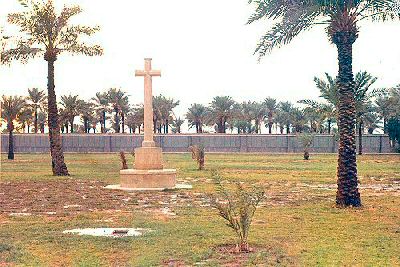
Amara War Cemetary (photo courtesy http://www.greatwarci.net)

Arthur Charles was four years younger than Sidney. He was 18 when war was declared on 4th August 1914. Five days later, full of patriotic fervour, Arthur had enlisted. He was posted to the 7th Reserve Cavalry Regiment which was responsible for training men for the 21st Lancers. Arthur had become a 'Lancer of the Line', a cavalryman. He saw no action for the first two years, staying on home soil. In March 2016 he requested a transfer under para 333 (iv) of the King's Regulations. This enabled him to move to the regiment where his older brother, Sidney, was serving. They were only together for a short time as Sidney was soon on the move to the Royal Welsh Fusiliers and Mesopotamia. Sadly, the three short months between March and June was the last time that the two brothers were together.

Signing up for war (photo courtesy IWM)

Arthur stayed with the 16th Battalion, Royal Fusiliers until July when he was posted to the 32nd Battalion, Royal Fusiliers. In August he was dispatched to France where he saw his first action. Unfortunately, in October, he received a gunshot wound to the neck and right shoulder so was shipped back to hospital in Blighty. Within six months he was back in France, but in June 1917 he was shot again, this time in the left cheek. Once more, it was back to the UK for treatment, before returning to France in January 1918.

During his time at home and in France, he was steadily being promoted through the ranks until by March 1918 he had attained the rank of Sergeant. In October, just weeks before the armistice, Arthur was wounded again, this time with a shrapnel wound to the shoulder. But two gunshot wounds and shrapnel wasn't enough to put Arthur out of action for good. He served out his time, finally being discharged in April 1919. A year later he was married to Louisa, and they were have to have one son together. In 1952, in their mid 50s, Arthur and Louisa embarked on a journey to the other side of the world when they emigrated to South Australia. Sadly Arthur died in 1956, having only enjoyed four years of his new life.

The youngest son, Herbert James, was a mere stripling when war broke out. He was just 15. But this didn't stop him from enlisting at the earliest possible opportunity. In July 1915, at the age of 16, he signed up with the Royal Regiment of Artillery. He was under age so told the recruiting office that he was 19 years and three months old. The lie went undiscovered until the following March when he was discharged under Para 392 VI (a) of the Kings Regulations. Herbert's career as a soldier was over. But only temporarily...

A battery in the Royal Field Artillery

He must have re-enlisted when reaching the age of 18 because it's as a Gunner in the Royal Field Artillery that Herbert lost his life. He was killed in action on 4 August 1918 whilst serving with 'H' Battery, 38th Brigade. He was initially buried in Abeelz French Military Cemetery, however in 1924 his body was disinterred and reburied in Cabaret-Rouge Cemetery in the Pas de Calais. This was part of a programme to 'concentrate' burials from a range of smaller burial grounds into a larger focused area. For his mother Fanny, who had lost two sons in the conflict, this must have been a time of reopened wounds. She requested that his grave be marked with a simple statement: 'Until the Day Break'...

'Until the day break, and the shadows flee away, turn, my beloved, and be thou like a roe or a young hart upon the rugged mountains'.

(Song of Solomon 2:17)

Sunday, 22 June 2014

Ernest Addington Pitts: A Genealogist's Dream

It was his name that attracted me. Ernest Addington Pitts. Not quite double barrelled but still with an air of gentility to it. As it turns out, Ernest may have started as a young man living on independent means but he didn't necessarily end up that way.

He was a dream ancestor to research - I found him on every census; there were migratory records; divorce records; he's mentioned briefly in a book; he appears on electoral rolls; in prison records; his WW1 service record survived the destruction of so many others during WW2; and to end the story of his life, he had a brief obituary in his local paper.

Ernest is my third cousin, three times removed. So he's fairly distant. Our shared ancestor is my five times grandfather, Luke Addington, a Bedfordshire ag lab through and through, who was Ernest's two times grandfather.

Ernest's grandfather, Isaac Pitts, is listed on the various census records as a slater, a masoner or a bricklayer. On one census he calls himself a proprietor of houses which I believe means he owned and rented out homes. He had clearly found himself in the property business and although living apart from Ernest's grandmother for most of their marriage, he was able to put his children through boarding school and leave £300 to his wife in his will.

Ernest's father, also called Isaac, lived by independent means or as an annuitant all his life. So in 1873 Ernest was born into a comfortable home in Chawston, Bedfordshire, a small hamlet eight miles north-east of the county town of Bedford.

Chawston, late 19th century

At the age of 7, in 1881, he was living with his parents in his grandmother's home, Box Cottage, in Chawston. The family must have been living comfortably off of his grandfather's pension as his grandmother and parents are listed as annuitants, and Ernest is a scholar. Ten years later, Ernest and his parents are still living off their own means, helped along by the £450 that his grandmother had left in her will, having died eight years previously. Ernest's father Isaac describes himself as a gentleman in the probate records.

Isaac died in June 1891 leaving a substantial sum behind him. But how much of this money made it to his widow and son needs to be ascertained as by the turn of the century they were both living in central Bedford with Ernest making a living as a commercial traveller.

At some point on his travels, Ernest met Edith Heydon and they were married in August 1901 in Marylebone, London. Edith was the daughter of a coal merchant from Devon. Ernest's address at the time of his wedding was the rather impressive sounding 292 Regent Street, London. A grand thoroughfare today, at the time of Ernest's residence it was being substantially rebuilt, taking on the appearance we see now, so it may not have been quite as grand as one imagines.

It is around this time that Ernest starts to stray from his hitherto good reputation. Quite unexpectedly I came across a prison record for him! In the first decade of the twentieth century, Ernest had been making a living as a 'stationer and fancy goods dealer' in Clapham Junction, London. However, in 1907 he was sentenced to 12 months in Wormwood Scrubs for obtaining property by false pretences, unlawfully obtaining credit, common law forgery and uttering. His citation states that he'd been up to no good since at least 1903. It appears my Ernest was a bit of a forger. Thankfully, on release from prison he was able to continue his stationer's business for a few more years.

In the clink

But it's also around this time that Ernest's marriage to Edith starts to look a little unsettled. On the 1911 census, Ernest is living in Sherborne, Dorset and states his occupation to be an organist. Edith meanwhile is living with her mother in Woking, Surrey, along with John, her three month old son by Ernest. Had she left him because of his criminal activities or for other reasons, yet to be discovered?

In 1914 with the outbreak of war, Ernest immediately enlisted. However as he was 41 in 1914, and also said he was a dairy farmer on his enlistment records, he was assigned to the 447th Agricultural Company in the Labour Corps, and consequently did not see military action overseas. He would have worked on the land ensuring food production was kept up at a time when there were major labour shortages. He began his Labour Corps career as a private with the Royal Bucks Hussars Reserve Regiment, but steadily rose up the ranks until, in 1917, he was promoted to Company Quartermaster Sergeant. He did well during the war years though he believed that the rheumatism that he developed in his feet was due to his war service. Was he not used to being on his feet all day? The army were having none of it though. They rejected outright his claim for a war pension stating his symptoms appeared to be 'subjective'.

Between his demobilisation in 1919 and 1925, Ernest appears to have continued his occupation as a dairy farmer. He co-owned a business in Islington, London called "E Jones: Dairymen, Cow-keepers and Provision Merchants". Whether Edith is with him I cannot tell, but I think it is unlikely. Most of her life from 1911 onwards appears to have centred around Woking.

In March 1925 Ernest's life was to change forever when, aged 51, he boarded the S.S. Ballarat, destination Australia. He settled in New South Wales and initially made his living as a driver. His wife and son did not emigrate with him and in 1935 Edith filed for divorce. Interestingly, within two years both had remarried. It's clear that new prospective marriage partners had prompted the need to separate offiicially so that both could marry again. In Ernest's case he married Beatrice Wyatt in 1936 in Sydney, citing 'organist' as his occupation.

SS Ballarat

Ernest as an organist is one side of his life which crops up time and again. He gets a blink-and-you-miss-it mention in a book by Anthony Paice called 'The Professional Beggar' (about the life of a Surrey clergyman) where it states Ernest was the organist at St Nicholas' Church in Pyrford, Surrey. And in a June 1895 issue of the Northampton Mercury, Ernest is mentioned as the organist at the wedding of a Miss Tyringham and Captain Cookson at Turvey in Bedfordshire. He states on the 1911 census that his occupation is organist, and likewise on several Australian electoral rolls.

Organist

Beatrice and Ernest lived together until his death just two years later in 1938. His brief obituary in the Sydney Morning Herald says simply: "February 27 1938 at the Masonic Hospital, Ashfield. Ernest Addington Pitts, dearly loved husband of Beatrice M. Pitts."

I loved researching Ernest. Records for his life seemed to be falling around my ears. Perhaps it's because he has a fairly unique name, and one that not many transcribers stumbled over, that the available records were easily found and accessed. There were so many different types of records available too - migration, census, prison, bmd - that his life became well rounded and interesting. He definitely seemed to have two sides to his nature. He was not averse to trying his luck for his own ends, whether it be through forgery or attempting to weasle a pension out of the army. And yet he was also a church musician, a passionate organist. Was this where Ernest's true vocation lay? He was relatively young when he died, only 64, but his life was packed with incident and variety. I think he was a real go-getter, not afraid to try new things. For some reason I visualise him as a tall man with glasses. But mostly I picture him as seated at a church organ, lost in the music he is making, serene and content, if only for just that moment in time.

Sunday, 20 January 2013

A Witness to History

Family legends are wonderful tools for the family historian. How often do they turn out to be real and how often complete fiction? It's usually the case that a story started out truthful but, through Chinese whispers, ended up somewhat different. Through careful probing and research, it's possible to get to the root of the matter so that the actual facts emerge. One of our family legends is that, as a young woman, my paternal grandmother, Esther May Cullip, observed a little bit of history as it happened. The story goes that, in 1916, Esther May witnessed the first ever shooting down of a German airship, watching it fall out of the skies. That year there were two incidents involving airships being shot down, both happening within a month of each other and in the same area. Family legend says my grandmother saw the first airship be destroyed, but whether or not this is the case, I do believe that Esther May witnessed one of these incidents in the autumn of 1916.


A Zeppelin airship

The Zeppelin Raids had begun a year earlier when Germany's ruler, Kaiser Wilhelm II, gave his approval for airships to cross the English Channel and target military establishments in places such as East Anglia and the south coast of England. He initially forbade the bombing of London due to the risk of killing a member of the royal family! King George V was his first cousin after all. However by the end of the year, raids were being carried out over the capital city.

The airship falling over Cuffley
The first airship to be shot down over British soil happened in the small hours of 3rd September 1916. Lt Leefe Robinson spotted the ship whilst on night patrol in his fighter plane. Approaching the airship from below he emptied his machine gun first into one the side of the ship, then the other, before firing shots into the rear. The back of the ship burst into flames resulting in the Schutte-Lanz SL11 ploughing into the ground in Cuffley, Hertfordshire. A dreadful choice had to be made by the crew. Should they jump or await the horrible fate of burning to death. Whatever their decision, the commander of the ship and his 15-man crew all perished.

As the crow flies, Cuffley is about eight miles from East Finchley and judging by newspaper accounts of the day, the event was witnessed by thousands of Londoners:

"The most amazing fact in connection with the downing of a Zeppelin on Saturday night, was the immense number of people who witnessed the spectacle despite the lateness of the hour. Warning of an imminent raid was given out early, and spread with astonishing speed by hundreds of channels which each fresh raid increases. Thus many thousand Londoners remained out of their beds out of curiosity awaiting development, in the hope that, if the raid materialised, they would see what was to be seen.
When the raiders approached the capital, the firing of guns and the dropping of exploding bombs seemed to wake up half London. Thus the actual burning was witnessed from every suburb and almost from every street. The Zeppelin's height enabled the watchers for miles around to gaze at the awe-inspiring spectacle, and its absorbing brilliancy as the airship fell."
(The Great War in Europe, Kalgoorlie Western Argus, 12 Sept 1916)

Esther May and Gladys, c.1917
My grandmother lived her entire life in East Finchley, north London, and by the beginning of September 1916 she was a new mother with a six week old daughter on her hands. Perhaps the crying of a small baby meant that Esther May was awake at 2am in the morning, or maybe it was the sound of gun fire and explosions that woke her up and drove her outside to watch this extraordinary event take place in front of her eyes. For my grandmother, a little bit of the war had come to her doorstep.

The Zeppelin L31 falling
over Potters Bar
The second airship was shot down less than a month later. On 1st October 1916, 2nd Lt Wulstan Tempest was responsible for the destruction of Zeppelin L31. This ship crashed into an oak tree in Potters Bar, Hertfordshire. Again, the whole crew died and their death was witnessed by thousands of Londoners who watched as the burning ship crashed to earth.

I'll never know which airship Esther May saw falling from the skies. I like to believe it was SL11, the first and most famous of the airships shot down over Britain. Either way, my grandmother did witness a bit of history in the making. But we mustn't forget that even though a burning airship would have been a dramatic spectacle to watch, it was also a tragedy, as all the German airmen died in horrible circumstances. The Zeppelin Raids aren't well remembered due to the overwhelming horror of the Blitz and the destruction wrought on Britain by the German air raids of the Second World War. So let us not forget the 500 civilians, all over the country, who died when a bit of World War One came to their shores.

Sunday, 6 January 2013

Levi Alfred King 1892-1954

It's been nearly two months since I last wrote on my blog. Not good, slapped wrists! So I've made one of my new year's resolutions for 2013 to blog more. To start things off here is a post about an ancestor whom I have chosen completely at random (I closed my eyes and picked his name off a list!).

Levi Alfred King is a fairly distant relation, the husband of my second cousin twice removed on my father's side. However he's one of the few people whose First World War service record survived the bombing during the 1940 Blitz in London and so I've got a pretty full account of his wartime experience.

But I'm jumping the gun. As Julie Andrews would say, let's start at the very beginning...

Levi was born in the first months of 1892 in Hadley Wood, Barnet, in what was then the county of Middlesex. This was a quiet, rural part of the world where his father, Alfred, was employed as an ostler at a local inn and his mother, Edith, was a dressmaker.


I'm quite curious as to why he was baptized Levi. His siblings all had more traditional Victorian names such as Henry, Arthur and Florence. Interestingly though, in a survey of the top 1000 names in the 1890s in the US, Levi was number 207, so by no means an unpopular name.

Life was ordinary for the first years of Levi's life. He was to be joined by five brothers and sisters, all of whom survived childhood, and with 13 years separating the eldest from the youngest, it must have been a noisy and chaotic household.

By 1914 the 22-year old Levi had reached the height of 5 ft 11 inches and at 121 lbs must have been fairly tall and thin. He was employed as an Emulsion Washer in a photographic studio. I'm not quite sure what an Emulsion Washer did but I'm thrilled to think he worked in what was still a pioneering industry, even though his job may have been quite menial.

His work in a photographic studio wasn't to last for much longer however, as in August of that year Britain declared war on Germany. Levi was the perfect age to sign up and serve his country and enlistment was to follow a year later on 23rd October 1915. At the age of 23 years and 10 months Levi enlisted in the Royal Army Medical Corps (RAMC). He stayed on home soil until August 1916 after which he was posted to France and Flanders.

The job of the RAMC was to provide medical backup to the front line troops. They operated the Field Ambulances and the Casualty Clearing Stations (CCS) where injured men were sent to be treated before returning to the trenches or before being moved on to one of the Base Hospitals which were also operated by the RAMC.

The RAMC at work on World War One battlefields

Levi was initially posted to the 70th Field Ambulance in September 1916. A couple of months later in November he was posted to Casualty Clearing Station 17 at Remy Siding, near Poperinge in Belgium where he was to spend the remainder of the war. He was even admitted a couple of times to his own CCS suffering from ailments such as influenza which laid him low for six days.

The buildings at Remy Siding in 1920

Remy Siding was so named because of its location next to the railway line which linked the CCS to Poperinge. The town itself was close to the battlefields of Ypres, Messines Ridge and Ploegsteert Wood, and as can be seen on the map, there were trenches situated fairly close to the CCS. Although Levi wasn't a fighting soldier, he would have witnessed more than his fair share of appalling sights. One can only imagine the atrocities that he would have seen: dreadful injuries, death and anguish on a far too common basis.

Trench map showing the location of CCS 17 at Remy Siding

Nevertheless there was some relief from the war for Levi, for in December 1917 he was granted 14 days leave to return home and marry his sweetheart, Emily Esther Cullip. They were married in Christ Church, Barnet with their family and friends around them.

But this was only a short respite as, too quickly, Levi had to return to the war. He would be away from home until February 1919 when he was demobilised and able to return to his new wife. His time in the RAMC had been exemplary with no misdemeanours to blight his service record. He was rewarded with the British War Medal and Victory Medal.

As is so often the case in those years following the 1911 census and World War One, the story of Levi's life goes cold. However I do know that he had at least one daughter, Gladys, born in 1924 and that he died in 1954 at the age of 62, still resident in Barnet. He left a grand total of £376 14s 4d in his will, a tidy sum in those days.

Writing a blog about a randomly selected ancestor brings them to life. I'd not really thought about Levi much before (no disrespect intended), but looking back over his life and looking at the surviving records which tell us the dates and facts about his existence he has become real to me. I now picture a fairly tall, skinny man, conscientious in his work, honest and law-abiding, and for some strange reason, dark haired and with a moustache! I can't back up those last details but I'm sure I'm right about the rest...

Sunday, 11 November 2012

The Heroes in my Family


On this day of remembrance I felt it was only appropriate to write a few words about my hero ancestors. My family is not unique. Like everyone who delves into their ancestry I have found many family members who went off to fight for their country, to 'do their bit'. Some made the ultimate sacrifice and were laid to rest where they died; some don't have a final resting place; all live on through stone memorials. Others were fortunate enough to make it through their war and return to homes and families. They may not have returned unscathed, either mentally or physically, but return they did. They aren't marked on a memorial but, like their fallen brethren, they are remembered. To me, they are all heroes.

Charles Stracey 1894-1917
My great uncle Charles was 22 years old when he died in France on 17th February 1917. A private in the 6th Battalion, Princess Charlotte of Wales (Royal Berkshire) Regiment, it's probable that he died during the action taken at Miraumont to capture several German trenches. During the early hours of the 17th February, as the troops assembled in preparation to go over the top, the Germans heavily barraged the assembly areas. Most of the day's casualties happened as a result of this barrage and I believe, as Charles' body was never recovered, that it was at this point that he died. His name is recorded on the great Thiepval Memorial to the missing in northern France.

Samuel Ezekiel Hardwick
Samuel Ezekiel Hardwick 1881-1917
Sam Hardwick, my great grand uncle, died of wounds on 7th April 1917. He was a private in the 8th Battalion, Queen's (Royal West Surrey) Regiment. I've been unable to work out where or when he was injured but I find it quite distressing to think that he may have suffered dreadfully in a casualty clearing station before finally succumbing to his wounds. He is buried in Calais Southern Cemetery (which I'm glad to have visited in 2010 to lay some flowers on his grave) and left behind a wife and seven year old daughter.

James Ivanhoe Cullip 1894-1918
James is an ancestor that I've written about before. One of my great uncles, he served as a gunner in the Royal Garrison Artillery, one of the men employed to pound the German lines with their big guns. He survived the war but tragically died two weeks before the armistice, and just one week after getting married, as a result of the Spanish Flu pandemic.

Thomas William Cullip 1899-1964
Great Uncle Thomas had been 18 years old for just two weeks when he enlisted in the Royal Navy in 1917. After training on HMS Pembroke he became a member of the crew of HMS Juno in March. He served on Juno until he was demobbed in April 1919.

Albert Edward Cannon (born Cullip) Born 1897
My first cousin twice removed, Albert Cannon, enlisted aged 19 in the Royal Garrison Artillery in 1915. Luckily for me, his is one of the few surviving service records which gives a wealth of information about his time in service. He survived the war and even volunteered for the Army of Occupation in 1919. After demobilisation in 1920 he sailed to Canada where he married and created a new life away from a war weary Europe.

Albert Stracey 1883-1945
My great uncle Albert also survived the war but suffered for the rest of his life from the effects of shell shock. He enlisted into the Royal Berkshires in 1915 at the age of 32. However, just 18 months later he was discharged from service under Paragraph 392 of King's Regulations 1912. He was deemed no longer physically fit for war service and issued with the Silver War Badge. My father remembers how Albert would sit in his chair and physically shake, an affliction he suffered with for the rest of his life.

Nathaniel Joe Stracey
Nathaniel Joe Stracey 1891-1961
My grandfather is another person I've written about previously. He served in the 5th Battalion, East Kent Regiment, the 'Buffs', in Mesopotamia and India. He survived the war unscathed.

John Stracey 1885-1949
I believe my great uncle John may have been one of the Old Contemptibles. Before the war he was a soldier in the regular army, serving as a private in the 1st Bedfordshire Regiment and his medal record shows that he qualified for medals from the 16th August 1914 - he was in it from the start! He may have fought at such major battles as Mons, Ypres and the Somme. Incredibly, he survived the whole four years of war.

Joseph Roy Stracey
Joseph Roy Stracey 1922-1942
I've written quite a lot about my uncle Roy so please see my previous post for an account of his brief life and death. Roy was a royal marine serving on HMS Hermes when it was attacked and sunk by Japanese fighter planes on 22nd April 1942. He was only 19 when he died and his name is recorded on the Plymouth Naval Memorial.


At the going down of the sun and in the morning,
We will remember them.

Sunday, 9 September 2012

Great Aunts and Uncles

My dad had lots of aunts and uncles on his mother's side. I don't think I realised quite how how many until I started investigating my family tree. As a child I remember visiting only one of them on several occasions. And that was my dad's Auntie Dot. We'd bundle into the car, drive up to her house and have tea in what my memory recalls as a tiny front room. I never looked forward to going; I wanted to stay behind and play with my toys. But I remember ultimately I always enjoyed those visits as Auntie Dot, or should I say my Great Auntie Dot, was a lovely person. I lament those lost opportunities to have talked to her about her life and the life of her siblings; of growing up in East Finchley, north London; living through the First World War; marriage; children; enduring the bombings of the Second World War; the birth of grandchildren. And, of course, she is now long gone, along with all her brothers and sisters. So this is my small tribute to them, to the relatives that I would give my eye teeth to talk to now. Unfortunately I know very little about any of them, but I think in many cases, the photos tell their story...

My grandmother, Esther May, was the eldest of the siblings, born in 1892 to James Cullip and Ann Esther Hardwick who came from Tempsford in Bedfordshire. By the time of Esther May's birth, the couple had relocated to East Finchley where all their children were born. I'm not going to go into any detail now about my grandmother as I will most definitely be posting a full blog on her in the future.

She was followed two years later by James Ivanhoe. I've already written at length about James. He tragically died at the close of World World One, just one week after he got married, after contracting the Spanish Flu virus. No photos have survived of him, however I do have a very poignant card that he sent to my grandmother Esther May. He must have sent it to her when he was serving in France as the card has been hand-made using a French post-card as the backing with a delicately embroidered image pasted on the front. The wording on the back simply states, 'with fondest love from Jim'.

The postcard that James sent to his sister, Esther May,
during World War One.

Mabel Elizabeth, known to everyone as Lizzie, was the third born, entering this world in 1897. She married a chap called Len Stevens and had three children by him. Most of the siblings lived to a good age, but Lizzie, along with her brother James, was the exception to the rule and sadly died in 1940 at the young age of 43.

This lovely photo shows a very happy family gathering. Lizzie is the lady on the far right. Her husband Len is resting his hand on her shoulder. I believe she is pregnant in that photo with her son Robert. My grandmother, the lady in white, also looks rather pregnant, which would mean this photo would have been taken in 1932. She is carrying my dad!

From left to right, my great uncle Tom Cullip and his wife Dora, my grandmother
Esther May, my grandfather Nathaniel Joe, my great aunt Lizzie, her husband Len.
The two boys are Tom and Dora's son, James, and my uncle Roy.

The fourth child to join the family was the second and last son, Thomas. During the First World War Thomas enlisted in the navy where he served on board HMS Juno. Luckily he survived the war unscathed and two years after his demobilisation he married Dorothy Bowen, otherwise known as Dora. They had one son, James. They are pictured in the photo above on the left hand side. He died in 1964.

And then lots of girls were born! The fifth child was Ethel Alice, born in 1901. She was known as Alice and married quite late in life at the age of 50. Her husband, Cecil Humby, was seven years her senior and a widower. He already had a daughter by his first marriage. They were to be married for 16 years as Cecil passed away in 1967 leaving Alice a widow for the next 18 years, until she too died in 1985. This photo shows Alice and Cecil on their wedding day. He looks very dapper in his suit with beautifully pressed trousers!

Alice Cullip and Cecil Humby's wedding day

Child number six was my Great Auntie Dot, who was baptised as Dorothy Mary. She married Ernest Bishop at the age of 24, had two children and lived to the ripe old age of 94. As I said earlier, she's the only aunt I have any semblance of a memory of. My childhood recollections are of a very warm and gentle woman. And of teas in front of her gas fire...

The next child to join the clan was born in 1906, Florence Winifred, known as Win. Win married Arthur Miller and had two children. She died in 1991 aged 85.

Win, wearing white

The penultimate child was Elsie Irene. She married Reginald Terry in 1934 but I've been unable to find any children for them. I have a wonderful photo, definitely one of my favourites, which shows Elsie with a 'trying not to laugh at the camera' expression on her face. She's failing dismally. She's seated on the ground, with her sister Win, in front of four elderly ladies, one of whom has the most fantastic outfit on. The ladies dressed in black look fairly stern, whereas Elsie can't seem to stop laughing. I would love to have known what the occasion was. I think I would have liked Elsie if I had got to know her. She died in 1999, aged 90.

Four stern old ladies, with sisters Win (left) and Elsie (right).

The last child and the baby of the pack, born in 1912, was Edith, known as Edie. She married William Boulton when she was 22 and had three children. She was a fairly well built and bespectacled young lady but  in every photo that I have of her she wears a wide beaming smile. As befits the youngest of the family she was the last surviving sibling and the only one to see in the new millennium. She died in 2004.

Edie holding a handsome young chap, my dad.

So I only really have the bare bones of facts for most of my great aunts and uncles. But I have a lot of photos and I feel that these images really reveal the inner souls and personalities of the people portrayed. They show siblings who got on well and clearly have a great affection for each other. There appear to have been numerous occasions when the family got together to celebrate births and marriages, or for day trips to the seaside, or just to gather for the sake of it.

Which brings me on to the last photo. This wonderful image is the only one I own which shows all the surviving siblings in one picture. I would guess that it was taken in the first years of the 1960s. My grandmother, who died in 1969, looks fairly elderly and frail and as her brother Tom, who is standing next to her, died in 1964, I feel this photo was probably taken around 1962. But that's just a guess. I love this photo for the fact that the ladies all look so smart with their pale coloured hats, white gloves and handbags. As most of them are wearing pigeon holes, they must have been attending a family wedding, but whose I don't know. It was probably one of the last photos taken of all the siblings together. It's a shame that both Lizzie and James were not alive to feature in it, but seven out of nine isn't bad!

From left to right, Edie, Elsie, Win, Dot, Alice, Tom, May.

Sunday, 12 August 2012

The Aunt I Never Knew

This is a blog post about asking the right questions. As a child I always knew my dad had a sister who had died long before I was born, but for years I knew almost nothing about her, she was just a name. It wasn't that Gladys was a black sheep in the family which meant she shouldn't be mentioned, it was more the case that my dad never spoke about any of his family. Or rather he never volunteered the information though he would happily talk about them if you asked. When I was young, and not interested in my ancestry, I didn't have the right questions in mind so never expanded my knowledge of what Gladys was like. It's only since I began investigating my family tree, using a combination of the available records, and pinning my father down to ask those all important questions, that I've managed to piece together Gladys' short life and put some flesh on the bones.

Gladys c.1920

Gladys was born on 14th July 1916 in East Finchley in North London, the first child of Joe and May Stracey. The world was embroiled in the Great War and so for the first few years of her life she would see little of her father who was away serving his country in Mesopotamia and India. For the duration of the war, Joe would carry a small photo of Gladys and her mother in his wallet.

Gladys and her mother - the photo
that Joe carried in his wallet
When she was six, Gladys was joined by a younger brother, Roy, and then ten years later my father completed the family. I know very little about her early years, however judging from the wonderful family photo albums that I have, it was a happy time, full of games, family occasions and childhood scraps.

From this point onward until her death, her life was a blank. I knew she had died at a fairly young age but my dad was not forthcoming with the cause. It was time to delve deeper and start asking questions.

So on a visit to my dad a couple of years ago, we were talking about family history and I casually asked him whether she had ever been married, expecting the answer to be in the negative as there had never been any mention of a husband or children. "Oh yes", replied my dad, "she married a POW". I was quite dumbfounded. After several years of researching my family tree and interrogating my father about his family and Gladys, he had never mentioned that his sister had been married. I don't blame him however, after all, I hadn't asked the pertinent question!

Samuel and Gladys McNairney
It turns out that Gladys had married a gentleman by the name of Samuel James Woods McNairney, in London, in 1951. He was, indeed, an ex-prisoner of war. Ancestry's British Army Prisoners of War dataset revealed that he had spent most of the war in a POW camp in Poland called Stalag XX-B. Further research on the internet explained how his battalion in the Royal Scots Fusiliers had been fighting a rearguard action during May 1940 to ensure the safe evacuation of troops at Dunkirk and that subsequently he had been captured. Gladys met him after the war when she was working as a cashier in a butcher's shop in Golders Green. My dad didn't particularly like him very much, describing him as "not a very nice man". That makes me feel quite sad as it has somewhat tainted my view of Samuel. I asked my father whether they had had children. I think I already knew the answer to that one, but it couldn't hurt to ask. "Oh no" replied my dad "she was much too old". She was 35 on her wedding day!

Gladys
Samuel wasn't Gladys' first love however. At some stage, most likely in the late 1930s, she met a young man called Donald Gabriel. He was a constable and they met one day on the East End Road in East Finchley. By all accounts he was her first serious relationship as they were engaged for a time. However, for reasons unknown, she broke off their engagement. Donald was a former pupil of the renowned Haberdasher Aske's Boys School in Hertfordshire and went on to join the army at the outbreak of the Second World War. Sadly he was not to survive. Dad thought he was in the Grenadier Guards and that he'd died in Burma but the only Donald Gabriel that I have found, via the Commonwealth War Graves Commission, is a Lieutenant in the Royal Indian Army Service Corp who died in 1943 and is buried in Baghdad. Donald and Gladys' relationship is the sort of information that would be almost impossible to find anywhere except through the recollections of a family member. Their romance would have been lost forever if my father had not recounted it to me.

But back to her marriage. Gladys and Samuel set up home in East Finchley just around the corner from the house in which she grew up. Sadly, however, they were only to be married for about eight years as in February 1959 Samuel died. Gladys moved back to live with her parents and brother although widowhood was to last just a few months. Later that same year, in early November, just months after the death of her husband, tragedy struck. Gladys had walked a fair distance from the local tube to her home and apparently walked into the house, sat at the kitchen table and had a massive heart attack. Her death certificate shows she had congestive heart disease and hypertension. But I was shocked when I noticed the date of her death. She had died on the 5th November on my father's 27th birthday.

Learning about Gladys has made me realise that it's the little details which can really make a person's history come to life. And these details so often come from a relative rather than an official document. They can also be found in newspapers, especially the splendidly written articles from the 19th century which never shied away from telling it how it was, full of juicy detail and commentary. But nothing beats the titbits you get from a relative as you then find out what they thought of the situation, or the person. That can only add flavour to an account of someone's life. So don't hesitate, quiz those relatives now, don't leave it until it's too late.

Gladys Stracey 1916-1959

Thursday, 2 August 2012

Mary Ann Matilda Ball 1848-1931

This is an account of another ordinary life, albeit one full of births, deaths and marriages. Mary Ann Matilda Ball is my paternal Great Great Grandmother. She lived to a good age, and although she seemed to have suffered more than her fair share of personal tragedy, I get an impression of a strong, persevering woman who, when necessary, stepped up to the plate and took on the responsibilities necessary to survive.

The Ripened Wheat by Jules Bastien-Lepage,
courtesy Wikigallery.org
Mary Ann was born in 1848, the year that revolution swept across Europe. However, the uprisings and social upheaval were a world away from Girtford, the small agricultural hamlet in Bedfordshire where Mary Ann was born. The hamlet lay on the Great North Road about two miles south of Tempsford where she was to spend all of her adult life. Her father, Edward, was an agricultural labourer. Her mother, Matilda, was to provide Mary Ann with her middle name.

By the time Mary Ann was recorded on her first census in 1851, the Ball family was complete. Mary Ann was the youngest child and, together with her two elder sisters, Fanny and Ellen, the family lived together in Girtford village. Their peaceful existence was not to last however as, in 1853, when Mary Ann was just two, Edward died at the young age of 28. His widow, Matilda, made a living from lace-making, a traditional livelihood in Bedfordshire, and supported her three young daughters single handed for the next ten years until she married for a second time in 1863. I believe that Mary Ann learned a lot from her mother about how to cope in times of adversity. She would have witnessed her mother's strength and I suspect this had a profound effect on Mary Ann's character and her own ability to strive through traumatic events.

Inside a Bakery by Gustaf Olaf Cederstrom, courtesy Wikigallery.org
At the age of 19 Mary Ann married a young baker from Tempsford, Samuel Hardwick. Together they lived in Langford End in Tempsford and raised four children, my great grandmother Ann, Fanny, Ellen and finally young Sam. Tragedy struck again however. When Sam was just a few months old, in June 1880, Samuel died of an epileptic fit. He was 33 years old. And this is when Mary Ann must have looked back and remembered her mother's resilience and incredible spirit, for she took over the family business and ran the bakery in the village. She was assisted by a journeyman baker, Henry Thompson, and her eldest daughter, my great-grandmother, Ann, who was only a child at the time. It was discovering that Mary Ann took on the bakery that made me develop a great admiration for her. She had a young family, including a tiny baby, and even though she probably had little choice but to take on the business, I still applaud her 'keep calm and carry on' attitude.

In 1885, Mary Ann married again. John Randall was a local man who worked as a general labourer. He had been born and bred in Tempsford, and the couple settled down to married life in the village that had been her home for the last 18 years. Mary Ann's propensity to give birth to girls continued with the birth of Alice, Florence and Winifred Mary.

Samuel Hardwick, died 1917
However, life was to deliver some harsh blows to Mary Ann, particularly in relation to her children. In 1882, two years after the death of her first husband and whilst still a young widow, her second born child Fanny died at the age of eleven. If that wasn't bad enough, eight years later, Mary Ann and John Randall's eldest, Alice, died of tubercular meningitis. She was 13 years old. And then came the war. Mary Ann's only son, Sam, was serving with the Royal West Surrey Regiment in France in 1917 when he was mortally wounded and later died of his wounds. Mary Ann outlived three of her children, a not un-common feature of life in the 19th and early 20th centuries. But it must have been devastating to lose two daughters to illness and then her only son in such a violent manner.

Mary Ann and John lived together in Tempsford until his death in 1928. She outlived him by three years and died at the ripe old age of 82.

Mary Ann, for me, is one of those ancestors that I just took to straight away. I admire how she stepped into her husband's flour-covered apron and made a living for herself and her family. Her's wasn't an easy life, it was marred by too much tragedy, but she survived, picked up the pieces and carried on. And because of that, she'll always be one of my heroes.

Sunday, 29 April 2012

Dorothy Lucy Bagley 1895-1940 - A Widow's Story

A while ago I related the sad story of my great uncle, James Ivanhoe Cullip, who survived the Great War only to die one week after his wedding in 1918 from the Spanish Flu pandemic. I was intrigued as to what became of his widow, Dorothy.

One can only imagine the range of emotions that she must have endured at the time. From the elation of her wedding in the local parish church, where they lived in East Finchley, London, through the worry that she would have felt when her new husband fell ill, to the incredible shock when death took him from her, and the subsequent grief of widowhood.

But evidence shows that she did pull through this dreadful time, as three years later she was to remarry. Her new husband was Alfred Walter Chappell, and I was surprised to see that they were married in Sawbridgeworth in Hertfordshire. The reason for my surprise was that Sawbridgeworth was the village where my grandfather, Nathaniel Joe Stracey, came from. He had moved to London in the first decade of the twentieth century and in 1916 married my grandmother, Esther May Cullip, the sister of James Ivanhoe. The Cullips originally hailed from Tempsford in Bedfordshire; they had had no connection with Sawbridgeworth except through my grandfather. So to see the widow of my great uncle getting married in Sawbridgeworth immediately sparked my interest and a desire to know more.

My first port of call was the 1901 census for Sawbridgeworth. On running a search for Alfred Chappell I was amazed to see that he lived next door to my 9-year old grandfather, Nathaniel Joe, in Bell Street. Alfred was 5 years old. Were they childhood friends? My instincts tell me they were.

The 1901 Sawbridgeworth census showing my grandfather,
Joe Stracey, living next door to Alfred Chappell.

I don't know where Dorothy lived following the death of James Ivanhoe. She may have returned to her parent's home, a few streets away from her new relations, or she may have moved in to what should have been the marital home with her father and mother-in-law. In any case, in this close-knit community where everybody knew everyone else, and to some extent, was related to everyone else, there would have been much contact between Dorothy and her new family. I believe that after Nathaniel Joe returned home from the war he probably had a visit from his old friend Alfred Chappell and introductions were made. This was a new beginning for Dorothy as, on Christmas Eve 1921, she married Alfred and they went on to have three children together.

But this isn't the end of Dorothy's story. Whilst researching Dorothy's death date, I was shocked to discover that her death was registered in 1940, just nine years after the birth of her third child. Why had she died at such a relatively young age? After further investigation, I discovered that Dorothy was one of five people who had been killed on the night of 10th October 1940 as a result of 'enemy action'. It was the height of the Blitz, and with Sawbridgeworth being so close to London, it appeared that a German bomber had dropped its load on Sawbridgeworth resulting in the deaths of two women and three young children. Three houses in Cambridge Road, where Dorothy lived, were to take the full force of the blast. Dorothy, who lived at number 108, was killed, along with a 10 year old girl who was staying with her at the time. Two children in the next door house, number 110, were also killed, along with a mother from number 112 who died of wounds the following day. You can read a moving account of the incident here.

What a sad end for Dorothy. Her first husband had survived the First World War only to fall victim to the raging flu pandemic. Then, having made a new life for herself in rural Hertfordshire, Dorothy was to meet a sudden and devastating death as a direct result of a German bombing raid over England. She was only 44. Seventy years after the Second World War, the happenings of that time can seem very far removed. But as I discover more and more family members whose lives were impacted by the cataclysmic events of the twentieth century I realise just how many ordinary people, and members of my own family, were effected by world events. Dorothy is a case in point, and sadly she was one of the thousands of people for whom the war came to her with such dreadful consequences. She is remembered on the Sawbridgeworth War Memorial, alongside the other innocent victims of that bombing raid.

The Sawbridgeworth War Memorial showing the names of
the victims of the German bombing raid of 10 October 1940.

Saturday, 31 March 2012

Nathaniel Joe Stracey 1891-1961 - A Life in Pictures

This is a photographic record of my grandfather's life.  I wish I had known him, but unfortunately he died a long time before I was born.  Photos are all I have to know him by, but I feel, judging by the photos I have, that I would have got on really well with him.

Nathaniel Joe Stracey was born in 1891 in the village of Sawbridgeworth in Hertfordshire, England, but had moved to East Finchley, north London by the time he was twenty.  There he married my grandmother, Esther May Cullip, and had three children.  An ordinary man, he lived through extraordinary times.  He served in World War One in Mesopotamia and India and lost his eldest son to the Second World War.  He first worked as a gardener and then became a postman.  He retired in 1957 when he received the Imperial Service Medal for 'long and meritorious service'.  Joe died in East Finchley in 1961, aged 70.

As a boy Joe was a member of the Boys Brigade, a UK wide
organisation founded in 1854.  Its aim was to promote "habits
of Obedience, Reverence, Discipline, Self-Respect and all that
tends towards a true Christian manliness"
. This is probably
the earliest photo of Joe, taken in the first decade of the 20th
century in Sawbridgeworth.

This is a teenage Joe, looking very smart and with a flower in his
 lapel.  He appears to be attending a wedding, although, as he got
married when he was 23, I don't believe this was taken at his own
marriage ceremony.  He looks far too young.

On the 1911 census, Joe was working as a gardener at a large house, the Grange,
in East Finchley.  But at the time of his marriage to Esther May he was working as a
gardener at Lambeth Palace, the London home of the Archbishops of Canterbury.
This photo could have been taken at either establishment.  But how smart they look
 - working men in overalls, yet wearing ties.

In December 1914 Joe married Esther May Cullip.  This is probably
their wedding portrait as Esther is displaying her wedding ring and
they are seated in the classic 'newly weds pose'.  By this time, Joe
was enlisted in the 5th Battalion of the East Kent Regiment, also
known as the Buffs.  He looks incredibly dashing...

With the Buffs, Joe traveled to Africa, India and Mesopotamia (modern day Iraq).
His diary, written in 1917, reveals the voyage he undertook, stopping at Freetown
 (Sierra  Leone), sailing past the Ascension Islands, landing in Cape Town, then Durban
 (South Africa) before finally disembarking in Bombay.  Their stay in India was short
however, as within three months they were in Mesopotamia, where Joe stayed until at
least 1919.  My grandfather is the tall chap in the back row with the moustache.  They
are all carrying, or wearing, pith helmets with sun protection.

A very relaxed Joe with puttees on his legs and his pith
helmet by his feet.  This photo was taken in either
Mesopotamia or India.

After Joe was demobbed he returned to East Finchley and his family.
His eldest child, Gladys, was born in 1916.  But it was not until 1922 that
his eldest son, Joseph Roy, was born, followed a few years later by my
dad.  This photo was taken in 1935 and shows Joe, Esther May, Roy and
my dad on the beach.  Joe is still wearing a tie!

In 1935 Joe became a postman, a job he held until his
retirement in 1957. Here he is standing proudly outside
his home in East Finchley, with Esther May in the
background, with his bike and postbag.

This photo was probably taken around 1940.  Although
their expressions are serious, it's a relaxed photo with
my dad resting his hand on his father's knee.

Happy and at ease in the late 1940s.

Joe died in 1961, aged 70.  He died in the house
he'd lived in for the last 40 years.  Esther May
followed him eight years later.