Showing posts with label East Finchley. Show all posts

Sunday, 17 March 2013

My Family During the War

My mum and dad were both children in 1939 when war was declared against Germany. I had never really understood what life was like for them during this period of history so I decided it was about time I found out. My mum is no longer with us, but her sister, my Auntie Trixie, has provided me with a wealth of information. My dad could also be relied upon to share his memories. In both cases, once the box was prized open, the stories poured out. Much laughter ensued as incidents and anecdotes were recalled for the first time in many years and I scribbled frantically to write it all down.

My dad on the left with a pal
Both my parents were seven years old at the outbreak of war. My dad lived with his family in East Finchley, north London. He wasn't evacuated but stayed at home for the duration. He has vivid memories of watching the Battle of Britain take place in the skies above him and for an eight-year old boy, with no real conception of life and death, this must have been one of the most exciting events to witness of his life so far. He can also recall the red glow in the sky as London burned during the height of the Blitz.

Small boys feel no fear. When the air raid siren sounded my father recollects sauntering down the road with a pal in no immediate hurry to get to the safety of the shelter. It was only when the air raid warden blew his whistle and shouted at them in no uncertain terms that they would make a dash for cover, most likely with a clip around the ear for punishment. Craters in the street and bombed out houses were a common sight, though luckily my father's road and its immediate surrounds were not hit. Dad remembers walking down a street one day and coming across a crater where a doodlebug had hit the day before. These sorts of happenings provided endless fascination and excitement. The exhilaration of London at war was not to last however. Tragedy struck the family when my dad's older brother, Joseph Roy, was killed whilst serving on HMS Hermes in the Indian Ocean. My father was only 10 but suddenly the reality of war was driven home.

My mum, Uncle Ernie and Auntie Trixie
(with uncontrollable red hair!)
There were no such tragedies for my mother and her family, though there was a very near miss! When war broke out my mother was living in Chelsea, in the heart of London, with her parents and two of her siblings. Her youngest brother was in Ireland with my grandfather's parents. When the family had come to England from Ireland in the late thirties it was decided to leave my Uncle Noel, then a toddler, behind, until the family were settled. Unfortunately the outbreak of war meant he was not able to join them until 1944 when he was nine years old. My aunt recalls going to collect him from Ireland and being aware that German U-Boats still patrolled the waters of the Irish Sea. But, being children, submarines were exciting rather than something to be scared of. I imagine my grandparents had rather different feelings on the subject during that crossing.

My mother's oldest brother, my Uncle Ernie, was also separated from his parents for a time. At the start of the war he had been sent to stay with his Grandma Lawton, my great-grandmother, in Sutton-in-Ashfield in Nottinghamshire, to convalesce following an illness. My great-grandmother was adamant that my mother and my aunt should join them to get them away from the dangers of the London blitz. My Nan however wanted her girls close and refused to let them go. It was only when my great-grandmother threatened to come down and collect them herself that my Nan relented and took her two daughters on the train to Nottinghamshire.

Life goes on in wartime London, 1940 © IWM (D 1303)
(
http://www.iwm.org.uk/collections/item/object/205196794)
And it's a good thing that they left that day as on that night in 1940 a bomb hit the block of flats where my family were living. It destroyed about a quarter of the building, unfortunately the quarter where my family had their home. My grandfather, who was now the only one at home and who had been asleep in bed at the time, dropped three floors. He survived because somehow his bed turned over in the fall and shielded him from the falling rubble. My poor Nan returned from Sutton-in-Ashfield, having left her daughters with her mother, to find her home destroyed and her husband in hospital. Luckily Grandad made a full recovery from his ordeal. But he was not the only one injured by the bomb. The old lady who lived across the hall was woken by the noise although her flat was not damaged. However, hearing the commotion she opened her front door to see what was going on and promptly fell three stories down. The hallway was no longer there! My aunt believes she survived. The bomb had fallen through my mother's and aunt's bedroom where they had been sleeping the night before. Did Grandma Lawton have a premonition that something was going to happen which is why she was so persistent that the girls be evacuated? We'll never know. But it's lucky she did as I would not be here today if it wasn't for her insistence.

Grandma Lawton
Grandma Lawton decided that she couldn't look after all three siblings herself so my aunt was sent to live with another relative a few minutes walk away whilst my uncle and mother stayed with their grandmother. Grandma Lawton was, by all accounts, quite a strict lady. The children would be told off for staring at themselves in the mirror. And my aunt recollects how, because her grandmother struggled to get a comb through my aunt's unruly mop of curly red hair, she was sent down to the hairdressers to have it all cut off. Of course, it grew back as curly as before.

After a year in Sutton-in-Ashfield all three children returned to London. All seemed quiet but the attacks weren't over as it was not long before the infamous doodlebugs were to inflict their particular brand of terror and destruction on the populace. But for the children it was still a time of excitement. Back home in Chelsea, they returned to a new block of flats looked after by a warden who insisted all the children were home by 9pm. The children and their little gang of friends would have great fun running away from him when he was trying to get them inside. He would go and knock on Nan’s door who would deny all knowledge of her children still being outside and claim they were safely in. My naughty Nan! Bombed-out houses were sources of great adventure. The children would clamber over the wreckage, balancing over shattered floorboards through which they could see the floor and rubble beneath.

It was a time of danger and fun, excitement and tragedy. These were lives being lived and appreciated to their fullest extent. My auntie will be 82 this year and my dad will be 81. It's hard to imagine the child within, but just get them talking and the child soon returns.

Sunday, 20 January 2013

A Witness to History

Family legends are wonderful tools for the family historian. How often do they turn out to be real and how often complete fiction? It's usually the case that a story started out truthful but, through Chinese whispers, ended up somewhat different. Through careful probing and research, it's possible to get to the root of the matter so that the actual facts emerge. One of our family legends is that, as a young woman, my paternal grandmother, Esther May Cullip, observed a little bit of history as it happened. The story goes that, in 1916, Esther May witnessed the first ever shooting down of a German airship, watching it fall out of the skies. That year there were two incidents involving airships being shot down, both happening within a month of each other and in the same area. Family legend says my grandmother saw the first airship be destroyed, but whether or not this is the case, I do believe that Esther May witnessed one of these incidents in the autumn of 1916.


A Zeppelin airship

The Zeppelin Raids had begun a year earlier when Germany's ruler, Kaiser Wilhelm II, gave his approval for airships to cross the English Channel and target military establishments in places such as East Anglia and the south coast of England. He initially forbade the bombing of London due to the risk of killing a member of the royal family! King George V was his first cousin after all. However by the end of the year, raids were being carried out over the capital city.

The airship falling over Cuffley
The first airship to be shot down over British soil happened in the small hours of 3rd September 1916. Lt Leefe Robinson spotted the ship whilst on night patrol in his fighter plane. Approaching the airship from below he emptied his machine gun first into one the side of the ship, then the other, before firing shots into the rear. The back of the ship burst into flames resulting in the Schutte-Lanz SL11 ploughing into the ground in Cuffley, Hertfordshire. A dreadful choice had to be made by the crew. Should they jump or await the horrible fate of burning to death. Whatever their decision, the commander of the ship and his 15-man crew all perished.

As the crow flies, Cuffley is about eight miles from East Finchley and judging by newspaper accounts of the day, the event was witnessed by thousands of Londoners:

"The most amazing fact in connection with the downing of a Zeppelin on Saturday night, was the immense number of people who witnessed the spectacle despite the lateness of the hour. Warning of an imminent raid was given out early, and spread with astonishing speed by hundreds of channels which each fresh raid increases. Thus many thousand Londoners remained out of their beds out of curiosity awaiting development, in the hope that, if the raid materialised, they would see what was to be seen.
When the raiders approached the capital, the firing of guns and the dropping of exploding bombs seemed to wake up half London. Thus the actual burning was witnessed from every suburb and almost from every street. The Zeppelin's height enabled the watchers for miles around to gaze at the awe-inspiring spectacle, and its absorbing brilliancy as the airship fell."
(The Great War in Europe, Kalgoorlie Western Argus, 12 Sept 1916)

Esther May and Gladys, c.1917
My grandmother lived her entire life in East Finchley, north London, and by the beginning of September 1916 she was a new mother with a six week old daughter on her hands. Perhaps the crying of a small baby meant that Esther May was awake at 2am in the morning, or maybe it was the sound of gun fire and explosions that woke her up and drove her outside to watch this extraordinary event take place in front of her eyes. For my grandmother, a little bit of the war had come to her doorstep.

The Zeppelin L31 falling
over Potters Bar
The second airship was shot down less than a month later. On 1st October 1916, 2nd Lt Wulstan Tempest was responsible for the destruction of Zeppelin L31. This ship crashed into an oak tree in Potters Bar, Hertfordshire. Again, the whole crew died and their death was witnessed by thousands of Londoners who watched as the burning ship crashed to earth.

I'll never know which airship Esther May saw falling from the skies. I like to believe it was SL11, the first and most famous of the airships shot down over Britain. Either way, my grandmother did witness a bit of history in the making. But we mustn't forget that even though a burning airship would have been a dramatic spectacle to watch, it was also a tragedy, as all the German airmen died in horrible circumstances. The Zeppelin Raids aren't well remembered due to the overwhelming horror of the Blitz and the destruction wrought on Britain by the German air raids of the Second World War. So let us not forget the 500 civilians, all over the country, who died when a bit of World War One came to their shores.

Sunday, 9 September 2012

Great Aunts and Uncles

My dad had lots of aunts and uncles on his mother's side. I don't think I realised quite how how many until I started investigating my family tree. As a child I remember visiting only one of them on several occasions. And that was my dad's Auntie Dot. We'd bundle into the car, drive up to her house and have tea in what my memory recalls as a tiny front room. I never looked forward to going; I wanted to stay behind and play with my toys. But I remember ultimately I always enjoyed those visits as Auntie Dot, or should I say my Great Auntie Dot, was a lovely person. I lament those lost opportunities to have talked to her about her life and the life of her siblings; of growing up in East Finchley, north London; living through the First World War; marriage; children; enduring the bombings of the Second World War; the birth of grandchildren. And, of course, she is now long gone, along with all her brothers and sisters. So this is my small tribute to them, to the relatives that I would give my eye teeth to talk to now. Unfortunately I know very little about any of them, but I think in many cases, the photos tell their story...

My grandmother, Esther May, was the eldest of the siblings, born in 1892 to James Cullip and Ann Esther Hardwick who came from Tempsford in Bedfordshire. By the time of Esther May's birth, the couple had relocated to East Finchley where all their children were born. I'm not going to go into any detail now about my grandmother as I will most definitely be posting a full blog on her in the future.

She was followed two years later by James Ivanhoe. I've already written at length about James. He tragically died at the close of World World One, just one week after he got married, after contracting the Spanish Flu virus. No photos have survived of him, however I do have a very poignant card that he sent to my grandmother Esther May. He must have sent it to her when he was serving in France as the card has been hand-made using a French post-card as the backing with a delicately embroidered image pasted on the front. The wording on the back simply states, 'with fondest love from Jim'.
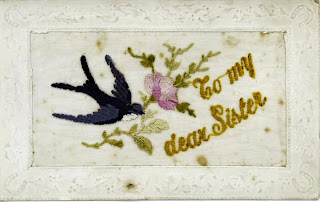
The postcard that James sent to his sister, Esther May,
during World War One.

Mabel Elizabeth, known to everyone as Lizzie, was the third born, entering this world in 1897. She married a chap called Len Stevens and had three children by him. Most of the siblings lived to a good age, but Lizzie, along with her brother James, was the exception to the rule and sadly died in 1940 at the young age of 43.

This lovely photo shows a very happy family gathering. Lizzie is the lady on the far right. Her husband Len is resting his hand on her shoulder. I believe she is pregnant in that photo with her son Robert. My grandmother, the lady in white, also looks rather pregnant, which would mean this photo would have been taken in 1932. She is carrying my dad!

From left to right, my great uncle Tom Cullip and his wife Dora, my grandmother
Esther May, my grandfather Nathaniel Joe, my great aunt Lizzie, her husband Len.
The two boys are Tom and Dora's son, James, and my uncle Roy.

The fourth child to join the family was the second and last son, Thomas. During the First World War Thomas enlisted in the navy where he served on board HMS Juno. Luckily he survived the war unscathed and two years after his demobilisation he married Dorothy Bowen, otherwise known as Dora. They had one son, James. They are pictured in the photo above on the left hand side. He died in 1964.

And then lots of girls were born! The fifth child was Ethel Alice, born in 1901. She was known as Alice and married quite late in life at the age of 50. Her husband, Cecil Humby, was seven years her senior and a widower. He already had a daughter by his first marriage. They were to be married for 16 years as Cecil passed away in 1967 leaving Alice a widow for the next 18 years, until she too died in 1985. This photo shows Alice and Cecil on their wedding day. He looks very dapper in his suit with beautifully pressed trousers!

Alice Cullip and Cecil Humby's wedding day

Child number six was my Great Auntie Dot, who was baptised as Dorothy Mary. She married Ernest Bishop at the age of 24, had two children and lived to the ripe old age of 94. As I said earlier, she's the only aunt I have any semblance of a memory of. My childhood recollections are of a very warm and gentle woman. And of teas in front of her gas fire...

The next child to join the clan was born in 1906, Florence Winifred, known as Win. Win married Arthur Miller and had two children. She died in 1991 aged 85.

Win, wearing white

The penultimate child was Elsie Irene. She married Reginald Terry in 1934 but I've been unable to find any children for them. I have a wonderful photo, definitely one of my favourites, which shows Elsie with a 'trying not to laugh at the camera' expression on her face. She's failing dismally. She's seated on the ground, with her sister Win, in front of four elderly ladies, one of whom has the most fantastic outfit on. The ladies dressed in black look fairly stern, whereas Elsie can't seem to stop laughing. I would love to have known what the occasion was. I think I would have liked Elsie if I had got to know her. She died in 1999, aged 90.

Four stern old ladies, with sisters Win (left) and Elsie (right).

The last child and the baby of the pack, born in 1912, was Edith, known as Edie. She married William Boulton when she was 22 and had three children. She was a fairly well built and bespectacled young lady but  in every photo that I have of her she wears a wide beaming smile. As befits the youngest of the family she was the last surviving sibling and the only one to see in the new millennium. She died in 2004.

Edie holding a handsome young chap, my dad.

So I only really have the bare bones of facts for most of my great aunts and uncles. But I have a lot of photos and I feel that these images really reveal the inner souls and personalities of the people portrayed. They show siblings who got on well and clearly have a great affection for each other. There appear to have been numerous occasions when the family got together to celebrate births and marriages, or for day trips to the seaside, or just to gather for the sake of it.

Which brings me on to the last photo. This wonderful image is the only one I own which shows all the surviving siblings in one picture. I would guess that it was taken in the first years of the 1960s. My grandmother, who died in 1969, looks fairly elderly and frail and as her brother Tom, who is standing next to her, died in 1964, I feel this photo was probably taken around 1962. But that's just a guess. I love this photo for the fact that the ladies all look so smart with their pale coloured hats, white gloves and handbags. As most of them are wearing pigeon holes, they must have been attending a family wedding, but whose I don't know. It was probably one of the last photos taken of all the siblings together. It's a shame that both Lizzie and James were not alive to feature in it, but seven out of nine isn't bad!

From left to right, Edie, Elsie, Win, Dot, Alice, Tom, May.

Sunday, 12 August 2012

The Aunt I Never Knew

This is a blog post about asking the right questions. As a child I always knew my dad had a sister who had died long before I was born, but for years I knew almost nothing about her, she was just a name. It wasn't that Gladys was a black sheep in the family which meant she shouldn't be mentioned, it was more the case that my dad never spoke about any of his family. Or rather he never volunteered the information though he would happily talk about them if you asked. When I was young, and not interested in my ancestry, I didn't have the right questions in mind so never expanded my knowledge of what Gladys was like. It's only since I began investigating my family tree, using a combination of the available records, and pinning my father down to ask those all important questions, that I've managed to piece together Gladys' short life and put some flesh on the bones.

Gladys c.1920

Gladys was born on 14th July 1916 in East Finchley in North London, the first child of Joe and May Stracey. The world was embroiled in the Great War and so for the first few years of her life she would see little of her father who was away serving his country in Mesopotamia and India. For the duration of the war, Joe would carry a small photo of Gladys and her mother in his wallet.

Gladys and her mother - the photo
that Joe carried in his wallet
When she was six, Gladys was joined by a younger brother, Roy, and then ten years later my father completed the family. I know very little about her early years, however judging from the wonderful family photo albums that I have, it was a happy time, full of games, family occasions and childhood scraps.

From this point onward until her death, her life was a blank. I knew she had died at a fairly young age but my dad was not forthcoming with the cause. It was time to delve deeper and start asking questions.

So on a visit to my dad a couple of years ago, we were talking about family history and I casually asked him whether she had ever been married, expecting the answer to be in the negative as there had never been any mention of a husband or children. "Oh yes", replied my dad, "she married a POW". I was quite dumbfounded. After several years of researching my family tree and interrogating my father about his family and Gladys, he had never mentioned that his sister had been married. I don't blame him however, after all, I hadn't asked the pertinent question!

Samuel and Gladys McNairney
It turns out that Gladys had married a gentleman by the name of Samuel James Woods McNairney, in London, in 1951. He was, indeed, an ex-prisoner of war. Ancestry's British Army Prisoners of War dataset revealed that he had spent most of the war in a POW camp in Poland called Stalag XX-B. Further research on the internet explained how his battalion in the Royal Scots Fusiliers had been fighting a rearguard action during May 1940 to ensure the safe evacuation of troops at Dunkirk and that subsequently he had been captured. Gladys met him after the war when she was working as a cashier in a butcher's shop in Golders Green. My dad didn't particularly like him very much, describing him as "not a very nice man". That makes me feel quite sad as it has somewhat tainted my view of Samuel. I asked my father whether they had had children. I think I already knew the answer to that one, but it couldn't hurt to ask. "Oh no" replied my dad "she was much too old". She was 35 on her wedding day!

Gladys
Samuel wasn't Gladys' first love however. At some stage, most likely in the late 1930s, she met a young man called Donald Gabriel. He was a constable and they met one day on the East End Road in East Finchley. By all accounts he was her first serious relationship as they were engaged for a time. However, for reasons unknown, she broke off their engagement. Donald was a former pupil of the renowned Haberdasher Aske's Boys School in Hertfordshire and went on to join the army at the outbreak of the Second World War. Sadly he was not to survive. Dad thought he was in the Grenadier Guards and that he'd died in Burma but the only Donald Gabriel that I have found, via the Commonwealth War Graves Commission, is a Lieutenant in the Royal Indian Army Service Corp who died in 1943 and is buried in Baghdad. Donald and Gladys' relationship is the sort of information that would be almost impossible to find anywhere except through the recollections of a family member. Their romance would have been lost forever if my father had not recounted it to me.

But back to her marriage. Gladys and Samuel set up home in East Finchley just around the corner from the house in which she grew up. Sadly, however, they were only to be married for about eight years as in February 1959 Samuel died. Gladys moved back to live with her parents and brother although widowhood was to last just a few months. Later that same year, in early November, just months after the death of her husband, tragedy struck. Gladys had walked a fair distance from the local tube to her home and apparently walked into the house, sat at the kitchen table and had a massive heart attack. Her death certificate shows she had congestive heart disease and hypertension. But I was shocked when I noticed the date of her death. She had died on the 5th November on my father's 27th birthday.

Learning about Gladys has made me realise that it's the little details which can really make a person's history come to life. And these details so often come from a relative rather than an official document. They can also be found in newspapers, especially the splendidly written articles from the 19th century which never shied away from telling it how it was, full of juicy detail and commentary. But nothing beats the titbits you get from a relative as you then find out what they thought of the situation, or the person. That can only add flavour to an account of someone's life. So don't hesitate, quiz those relatives now, don't leave it until it's too late.

Gladys Stracey 1916-1959

Sunday, 29 April 2012

Dorothy Lucy Bagley 1895-1940 - A Widow's Story

A while ago I related the sad story of my great uncle, James Ivanhoe Cullip, who survived the Great War only to die one week after his wedding in 1918 from the Spanish Flu pandemic. I was intrigued as to what became of his widow, Dorothy.

One can only imagine the range of emotions that she must have endured at the time. From the elation of her wedding in the local parish church, where they lived in East Finchley, London, through the worry that she would have felt when her new husband fell ill, to the incredible shock when death took him from her, and the subsequent grief of widowhood.

But evidence shows that she did pull through this dreadful time, as three years later she was to remarry. Her new husband was Alfred Walter Chappell, and I was surprised to see that they were married in Sawbridgeworth in Hertfordshire. The reason for my surprise was that Sawbridgeworth was the village where my grandfather, Nathaniel Joe Stracey, came from. He had moved to London in the first decade of the twentieth century and in 1916 married my grandmother, Esther May Cullip, the sister of James Ivanhoe. The Cullips originally hailed from Tempsford in Bedfordshire; they had had no connection with Sawbridgeworth except through my grandfather. So to see the widow of my great uncle getting married in Sawbridgeworth immediately sparked my interest and a desire to know more.

My first port of call was the 1901 census for Sawbridgeworth. On running a search for Alfred Chappell I was amazed to see that he lived next door to my 9-year old grandfather, Nathaniel Joe, in Bell Street. Alfred was 5 years old. Were they childhood friends? My instincts tell me they were.

The 1901 Sawbridgeworth census showing my grandfather,
Joe Stracey, living next door to Alfred Chappell.

I don't know where Dorothy lived following the death of James Ivanhoe. She may have returned to her parent's home, a few streets away from her new relations, or she may have moved in to what should have been the marital home with her father and mother-in-law. In any case, in this close-knit community where everybody knew everyone else, and to some extent, was related to everyone else, there would have been much contact between Dorothy and her new family. I believe that after Nathaniel Joe returned home from the war he probably had a visit from his old friend Alfred Chappell and introductions were made. This was a new beginning for Dorothy as, on Christmas Eve 1921, she married Alfred and they went on to have three children together.

But this isn't the end of Dorothy's story. Whilst researching Dorothy's death date, I was shocked to discover that her death was registered in 1940, just nine years after the birth of her third child. Why had she died at such a relatively young age? After further investigation, I discovered that Dorothy was one of five people who had been killed on the night of 10th October 1940 as a result of 'enemy action'. It was the height of the Blitz, and with Sawbridgeworth being so close to London, it appeared that a German bomber had dropped its load on Sawbridgeworth resulting in the deaths of two women and three young children. Three houses in Cambridge Road, where Dorothy lived, were to take the full force of the blast. Dorothy, who lived at number 108, was killed, along with a 10 year old girl who was staying with her at the time. Two children in the next door house, number 110, were also killed, along with a mother from number 112 who died of wounds the following day. You can read a moving account of the incident here.

What a sad end for Dorothy. Her first husband had survived the First World War only to fall victim to the raging flu pandemic. Then, having made a new life for herself in rural Hertfordshire, Dorothy was to meet a sudden and devastating death as a direct result of a German bombing raid over England. She was only 44. Seventy years after the Second World War, the happenings of that time can seem very far removed. But as I discover more and more family members whose lives were impacted by the cataclysmic events of the twentieth century I realise just how many ordinary people, and members of my own family, were effected by world events. Dorothy is a case in point, and sadly she was one of the thousands of people for whom the war came to her with such dreadful consequences. She is remembered on the Sawbridgeworth War Memorial, alongside the other innocent victims of that bombing raid.

The Sawbridgeworth War Memorial showing the names of
the victims of the German bombing raid of 10 October 1940.

Monday, 9 April 2012

Joseph Roy Stracey 1922-1942 and HMS Hermes

Today, 9th April 2012, is the 70th anniversary of the sinking of HMS Hermes off the coast of Sri Lanka in the Second World War. On board was a 19-year old marine, my uncle, Joseph Roy Stracey. Tragically, he was one of the 307 men who was lost when the ship went down.

HMS Hermes
HMS Hermes was the world's first purpose built aircraft carrier, launched in 1919. By the Second World War she was considered to be an old vessel. Nevertheless, she had a distinguished wartime career hunting for German U-boats in the Atlantic and tracking down enemy shipping in the Indian Ocean as part of the Eastern Fleet. The Eastern Fleet was formed in 1941 following Japan's entry to the war the previous December. Japan had experienced a series of successes in the Far East and, with these successes, was winning domination over the Indian Ocean. As a result Britain's vital shipping routes - which she needed to supply India and Ceylon with troops to avert any future invasion by Japan - were under threat. The Eastern Fleet's aim was to regain control of the Indian Ocean, with the fleet temporarily based at Trincomalee on the island of Ceylon.

On 5th April 1942, Japan attacked the Ceylonese naval base at Colombo sinking several ships. Then, four days later on the 9th April, they turned their sights to Trincomalee. The ships which had been in harbour, including HMS Hermes, had received prior warning that there was going to be an attack so had sailed out into open waters. It was on their return to Trincomalee that they were spotted by Japanese reconnaissance aircraft and attacked by over 30 fighters. She received 40 direct hits and sank within ten minutes.

The HMS Hermes burns after being attacked by Japanese aircraft.
This photo was taken from a Japanese plane.
HMS Hermes sinking following her attack by 30 Japanese fighters.

My 19-year old uncle was one of the many who died on that day.  Born and bred in East Finchley, London, he had enlisted in the Royal Marines a month before his 18th birthday. He must have been so eager to join up. Did he feel patriotic? Was he craving adventure in a wider world? His service record states that prior to enlistment he had been a factory hand, so becoming a marine must have offered excitement, a chance to see the world as his father had done in the previous war. And of course, at that age, one feels immortal.

Roy had six months of training at the Royal Marines Depot at Deal in Kent before spending the next four months in Plymouth. Whilst training he was pronounced 'good' at swimming, and qualified in Parade, Tactical Training, Naval Gunnery, Small Arms, Anti-Gas and Seamanship. He became part of the Hermes crew in December 1940.

He was tall, a six-footer like his father, and good-looking. In November 1941, the Hermes underwent a two and a half month refit in Simonstown, South Africa. It was there that Roy met the woman that, according to my father, he became engaged to. Her name was Lorraine and, unfortunately, that's all we know about her. Nonetheless, the one photo we have of them together speaks volumes as it shows two people very much enamoured of each other. It was a romance that was not to end happily as, less than three months after they parted, Roy was dead.

Roy and Lorraine in South Africa
I often wonder whether his body was recovered and is one of the unknown sailors buried in Trincomalee Cemetery. Or was his body consigned to the deep? I will never know. Either way Roy is commemorated on Plymouth Naval Memorial. The family have visited on several occasions to pay our respects and find his name amongst the thousands of other members of the Royal Navy who have no known grave. For me, I'm incredibly sad that I have an uncle that I never had a chance to know but I keep the photo of him and Lorraine on display in my home to ensure I never forget him.

This blog is in memory of my Uncle Roy and the other 306 men who died with the HMS Hermes.

Marine Joseph Roy Stracey 1922-1942

Saturday, 31 March 2012

Nathaniel Joe Stracey 1891-1961 - A Life in Pictures

This is a photographic record of my grandfather's life.  I wish I had known him, but unfortunately he died a long time before I was born.  Photos are all I have to know him by, but I feel, judging by the photos I have, that I would have got on really well with him.

Nathaniel Joe Stracey was born in 1891 in the village of Sawbridgeworth in Hertfordshire, England, but had moved to East Finchley, north London by the time he was twenty.  There he married my grandmother, Esther May Cullip, and had three children.  An ordinary man, he lived through extraordinary times.  He served in World War One in Mesopotamia and India and lost his eldest son to the Second World War.  He first worked as a gardener and then became a postman.  He retired in 1957 when he received the Imperial Service Medal for 'long and meritorious service'.  Joe died in East Finchley in 1961, aged 70.

As a boy Joe was a member of the Boys Brigade, a UK wide
organisation founded in 1854.  Its aim was to promote "habits
of Obedience, Reverence, Discipline, Self-Respect and all that
tends towards a true Christian manliness"
. This is probably
the earliest photo of Joe, taken in the first decade of the 20th
century in Sawbridgeworth.

This is a teenage Joe, looking very smart and with a flower in his
 lapel.  He appears to be attending a wedding, although, as he got
married when he was 23, I don't believe this was taken at his own
marriage ceremony.  He looks far too young.

On the 1911 census, Joe was working as a gardener at a large house, the Grange,
in East Finchley.  But at the time of his marriage to Esther May he was working as a
gardener at Lambeth Palace, the London home of the Archbishops of Canterbury.
This photo could have been taken at either establishment.  But how smart they look
 - working men in overalls, yet wearing ties.

In December 1914 Joe married Esther May Cullip.  This is probably
their wedding portrait as Esther is displaying her wedding ring and
they are seated in the classic 'newly weds pose'.  By this time, Joe
was enlisted in the 5th Battalion of the East Kent Regiment, also
known as the Buffs.  He looks incredibly dashing...

With the Buffs, Joe traveled to Africa, India and Mesopotamia (modern day Iraq).
His diary, written in 1917, reveals the voyage he undertook, stopping at Freetown
 (Sierra  Leone), sailing past the Ascension Islands, landing in Cape Town, then Durban
 (South Africa) before finally disembarking in Bombay.  Their stay in India was short
however, as within three months they were in Mesopotamia, where Joe stayed until at
least 1919.  My grandfather is the tall chap in the back row with the moustache.  They
are all carrying, or wearing, pith helmets with sun protection.

A very relaxed Joe with puttees on his legs and his pith
helmet by his feet.  This photo was taken in either
Mesopotamia or India.

After Joe was demobbed he returned to East Finchley and his family.
His eldest child, Gladys, was born in 1916.  But it was not until 1922 that
his eldest son, Joseph Roy, was born, followed a few years later by my
dad.  This photo was taken in 1935 and shows Joe, Esther May, Roy and
my dad on the beach.  Joe is still wearing a tie!

In 1935 Joe became a postman, a job he held until his
retirement in 1957. Here he is standing proudly outside
his home in East Finchley, with Esther May in the
background, with his bike and postbag.

This photo was probably taken around 1940.  Although
their expressions are serious, it's a relaxed photo with
my dad resting his hand on his father's knee.

Happy and at ease in the late 1940s.

Joe died in 1961, aged 70.  He died in the house
he'd lived in for the last 40 years.  Esther May
followed him eight years later.  

Thursday, 22 March 2012

James Ivanhoe Cullip 1894-1918

Names often hold a fascination for me.  When I discovered that my great uncle, James Cullip, had Ivanhoe as a middle name, I immediately wanted to know more about him.

Born in 1894 in East Finchley, north London, James Ivanhoe was the eldest son of James Cullip, a labourer, and Ann Esther Hardwick.  He grew up with one brother and seven sisters!  It must have been a noisy, chaotic household.  This family of ten moved several times but always within the same two terraced streets of East Finchley where everybody knew everyone else.  The children's neighbours were uncles and aunts, half-uncles and cousins. In fact the census for both 1901 and 1911 shows that, in most cases, the children grew up in the same streets as their future spouses.

East Finchley, 1912
In 1902, along with two of his sisters and his brother Tom, James was baptized at the local church, Holy Trinity in East Finchley.  He was seven years old; it must have been quite a family event.  I assume that he had some schooling as a child, though, as the 1911 census reveals, by the age of 16 he was working as a 'gardener nurseryman'.  And that's all I know about his young life.

At the outbreak of the war in 1914 James was 20 years old but doesn't appear to have signed up, or been conscripted, for another two years.  His service record is one of the many which were destroyed in World War Two.  His medal card however, shows that he received the British War Medal and the Victory Medal which were earned by those who saw service after January 1st 1916.

James became a Gunner in the 140th Hammersmith Heavy Battery of the Royal Garrison Artillery.  The RGA were responsible for the heavy artillery, the units who were positioned behind the trenches bombarding the enemy lines with their howitzers and 60-pounder guns.  This battery first saw service in France in April 1916.  I need to make a trip to the National Archives to find out exactly which battles he was involved in, and where he was stationed.  What action did he see?  Nevertheless, James did survive the war and returned home to England.  And this is where the tale takes a tragic turn.

On 27th October 1918, two weeks before the Armistice, James married Dorothy Lucy Bagley at the Holy Trinity Church in East Finchley, the same church he had been baptised in.  The Bagleys were relative newcomers to the area.  Dorothy's father, Levi, was a local fishmonger and butcher.  For James and Dorothy however, married life was to be cut short in its infancy. Less than a week after the wedding James was dead, a victim of the Spanish Flu pandemic which cut young men down in their prime.  One can only imagine how utterly distraught Dorothy must have felt.  Her new husband had survived two years of an atrocious war only to be taken from her in a matter of days at a time when they should have been enjoying newly married life.

James is buried in the East Finchley Cemetery, just across the way from the terraced streets where he spent most of his short life, and is remembered on the War Memorial there.  It's ironic that James was to travel to France, endure the dreadful conditions of the Western Front, only to lose his life in his own backyard...

East Finchley Cemetery War Memorial