Showing posts with label Tempsford. Show all posts

Sunday, 22 February 2015

James Miles: From Soldier to Telephone Operator

I've recently started travelling down a branch of my tree that has been much neglected in my family history travels, that of my 3 x Great Grandmother, Ann Esther Ibbott Miles' family. As I find happens so frequently, one particular person intrigued me more than most: James Miles, my 1st cousin, four times removed.

James was the nephew of Ann Esther Ibbott Miles and it soon became apparent that he had led an interesting and varied life.

Born at the beginning of 1853 to James and Mary Miles in the small village of Tempsford, Bedfordshire, where so many of my ancestors hailed from, he was the youngest of nine children. His mother gave birth to him at the age of 48, nine years after her last child, so his arrival was probably a bit of a surprise to the family. His father worked the land, as James would have done around his schooling.

By the time he was 18, James was working as a footman at Longstowe Hall, near Cambridge. This grand Elizabethan pile was owned at the time by Sidney Stanley, local landowner and a Justice of the Peace for Cambridgeshire. This was a large and busy household as not only did Stanley and his wife have seven children but they were looked after by a huge staff ranging from the butler, governess and housekeeper at the top of the servant's ladder to a number of housemaids and laundry maids at the opposite end of the pecking order. It was all very 'Downton Abbey'!

Longstowe Hall (photo courtesy www.longstowehall.co.uk)
As a footman, James was not one of the senior or 'upper' servants. Although his days were long and he'd have been on his feet all day, his duties were deliberately undemanding. His main role was to be seen: serving meals, opening and closing doors, accompanying the carriage on journies. Dressed in an expensive uniform, his very presence in the house was to display his master's wealth. As the countryhousereader blog explains, having a footman was a sign of conspicuous consumption, a demonstration of riches. The footman was supposed to look good, so I can only assume, and maybe I'm a bit biased here, that James was a good looking young man. Getting employment as a footman was a good move for James, as he would have earned more than an agricultural labourer, of which many could be found in his family, and would have had room and board as a given.

The servants of Petworth House, Sussex in the 1870s.
Just the type of uniform that James would have worn.
(Photo via https://countryhousereader.wordpress.com/2013/12/19/the-servant-hierarchy/)

Perhap life in this large privileged household didn't offer enough excitement and challenge for the young James Miles as in 1878, when he was 24 years old, James began a whole new chapter in his life; one which offered the prospect of adventure and travel. On the last day of January of that year, at 11am in the morning, James signed up for 12 years service in the infantry of the British army. He was to spend his army career in the 4th Battalion, the King's Own (Royal Lancaster) Regiment who had their home barracks in Lancaster.

The badge of the 4th Battalion,
King's Own Regiment
James must have enjoyed the life of a soldier as he was to sign up for a second term, serving for 21 years in total. And what was there for him to dislike? He was clearly well respected as his service record (found in British Army Service Records 1760-1915 on findmypast.co.uk) shows that he was promoted up the ranks from private to corporal to sergeant, until by the time of his discharge he had attained the rank of colour sergeant. He did not see any action but served in several overseas outposts - Gibraltar, the West Indies and Ireland. The role of these outputs was to maintain the security of Britain's trade routes and to guard the British Empire's far flung frontiers.

A posting in Jamaica was once considered a death sentence, and James was not to escape illness. Even though he was stationed in Newcastle high in the Blue Mountains where soldiers were less susceptible to yellow fever, James still succombed to 'neuralgia' and later whilst in Up Park camp in Kingston, he fell ill with a fever that hospitalised him for two weeks.

The only blemish on an otherwise impeccable army career was his demotion from sergeant to corporal as a result of drunkenness in August 1884 whilst stationed at Castletown on the Isle of Man. My reaction to that was 'Oh James, why, oh why, did you do that?'. But it didn't stop him in his tracks and he was soon back on the promotional ladder. His service record states he had a 'very good' character and would have received many good conduct badges if he hadn't been promoted.

At the end of his second term, and exactly 21 years to the day since he had signed up, he was discharged from the army. He was 45 years old.

Bowerham Barracks, Lancaster - where James spent his 21-year military career.
(Photo: http://www.kingsownmuseum.plus.com/galleryaccommodation02.htm)

In 1890 he had married Annie Gregory, a Yorkshire lass born in Sheffield who had worked at the County Asylum located a stone's throw from the Bowerham Barracks in Lancaster where James lived and worked. They had three children in the space of five years. So it was in 1899 that James and his young family left Lancaster and the army life he, and they, had known for so many years, and relocated to Longsight in Manchester. It was here that James embarked on a new career in a relatively new industry. He became a telephone operator.

James worked for the National Telephone Company [NTC]. The industry had only been in existence since the 1870s with the NTC itself being formed in 1881 and it's around about this time that the first telephone exchange opened in Manchester. Most telephone operators were women, so it strikes me as unusual to find James in this role. However, this is the job that he did from at least 1901 to 1911. A caller would connect to the exchange where a telephone operator such as James would connect them to the required destination. I'm really proud to think that an ancestor of mine worked in a fairly pioneering industry.

James died on 16th February 1915 at his home in Levenshulme, Manchester. He was relatively young as he was only 62.

I became intrigued by him when I discovered on one census that he'd been a telephone operator and on an earlier census he'd been a soldier. What a change in occupation! He was an ordinary chap, and he probably considered a lot of his day to day life to be pretty humdrum, but I think he has a fascinating career history - full of variety and innovation. He demonstrated his character through his army promotions and he looked the future in the face when taking on new fangled telephones in the first decade of the twentieth century. He started his life in a small agricultural village and ended it in a major metropolis working in an industry of the future. His life exemplified how life for everyone changed so rapidly in the 19th and 20th centuries.

Sunday, 1 February 2015

Just your typical genealogical puzzle

I do like a good challenge. Last week I revisited the family tree of my 3 x Great Grand Uncle, George Cullip, who was born in Bedfordshire in 1802. I had done some brief work on his family a few years back so it was time to refresh my memory, confirm facts and double check all the sources.

I started with the 1841 census. This stated that George was living in Leeds with his wife Lucy and children Joseph (born, according to the census, in 1826), Cornelius (b.1831), Betsey (b.1836) and Mary Ann (b.1838). If I could find the children's baptism dates I would get a truer indication of when the children were born. I had previously discovered that when George married Lucy he was a widower. His first wife, Mary Ibbott, had died in Tempsford, Bedfordshire in January 1833. He subsequently married Lucy Stonebridge in 1837, again in Tempsford. I therefore decided to search for the baptism records in Tempsford for Mary and George's children. The Bedfordshire parish records are not yet online, so I turned my attention to familysearch.org. This opened up an unexpected can of worms which tested my powers of investigation no end.


The Leeds 1841 census showing the children of George and Lucy Cullip.
The five year old Betsey triggered much investigation, assumption and a speculative conclusion.
George is resident with the family but features on the previous page.

I ran a 'parent search' looking for the children of George Cullip and Mary. To my surprise, there were six results, rather than the expected three (Mary Ann being the daughter of Lucy):

John, baptised Oct 1822
Joseph and Elizabeth, baptised Oct 1828
Cornelius, baptised May 1830
James and Alice, baptised Jan 1833

My first conundrum was where were James and Alice? They weren't on the 1841 census living with George and Lucy. The date of their baptism was 27 January 1833, just four days after their mother Mary had been buried. I came to the sad conclusion that she must have died as a result of childbirth. But had they too followed Mary to the grave? I can only conclude that that is what happened as I have been unable to locate them on any further census records. And unfortunately definitive death records are proving elusive too.

Secondly, I was intrigued by the birth of John in 1822. As he wasn't living with his parents by the time of the 1841 census he had slipped through my radar. In my earlier investigations into George, I had found a gaol record for him on the excellent Bedfordshire Gaol Register website. George had been committed in August 1822 to three months hard labour for refusing to obey a bastardy order. He was actually serving his sentence at the time of John's baptism in October. My theory is that George initially refused to admit to being John's father and perhaps after contact with his son he relented as, a year later, in December 1823, he and Mary were married. Whether this marriage was born out of love or duty is a matter of conjecture. It was five years before they had any surviving offspring so was the marriage initially strained? Of course, it may be that John's mother was a different Mary as the name was so common in the 19th century, but I like to think it is the same woman. My next task is to try and get my hands on the bastardy order, hopefully that will resolve the issue.

My final puzzle related to Elizabeth Cullip, I had initially noted down that she was born in 1836 as per the 1841 census. But this couldn't be the case if her baptism was in 1828! Why would a 13-year girl be listed as being five? Plus if she was Joseph's twin (an assumption brought about by the fact that they were baptised on the same day) then why isn't she noted as being the same age as him? By the 1851 census Elizabeth is listed as being 18 years old, indicating she was born in 1833 - yet another difference in her year of birth. It was at this point that a light bulb switched on over my head and I wondered whether in fact there were two different children. On the 1841 census the child is called Betsey, a common pet name for Elizabeth, hence my initial confusion. So I returned to familysearch and hunted for any Betsy or Betsey, rather than Elizabeth, born around 1833 in Tempsford. There at the top of the list was 'Betsy Stonebridge or Hare', baptised July 1832, daughter of Lucy Stonebridge and James Hare. The indecision regarding her surname led me to conclude that she must have been illegitimate. I had found my girl.

A subsequent search of the National Burial Index revealed an Elizabeth Cullip who died aged seven in 1833 and was buried in the February. There were indeed two children, one of whom switched between her birth name of Betsy and Elizabeth throughout her life, causing future amateur genealogists some trouble! I can only assume that the enumerator made an error on the 1841 census by rounding her age down from eight to five.

As Elizabeth Cullip's death followed so soon after the death of her mother I wonder whether Mary didn't in fact die in childbirth but had succombed to an illness which she then passed on to her daughter. We will probably never know.

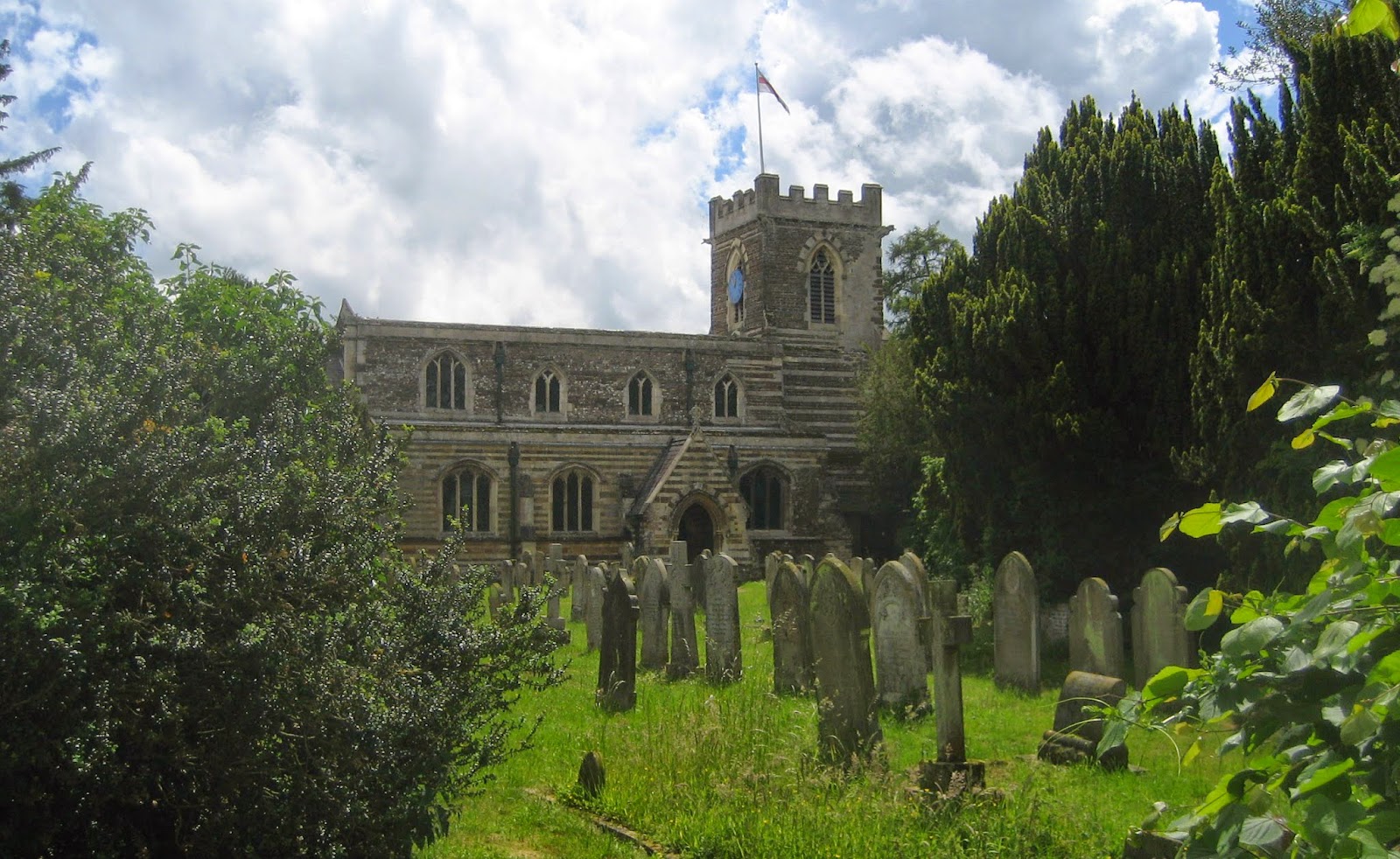
Tempsford Church: the scene of so many of my ancestors vital life events.
Elizabeth Cullip was baptised and buried here.

As ever when searching one's family history, just as one door closes, another opens. I have more questions now which need answering. Was John Cullip the child at the heart of the bastardy case; did Lucy and George have any children I've not discovered yet (a quick glance at familysearch thinks maybe they did); what happened to the twins, James and Alice, who disappear from history after their birth? I'm still not entirely convinced that my conclusions are correct. But isn't that one of the reasons why family historians love delving into their past, to turn private investigator and get their teeth into a juicy case. For me, the case is not yet closed, and probably never will be...

Sunday, 18 August 2013

Strangers in a small village

During a trawl through the British Newspaper Archive on Find My Past the other day I came across this wonderful little cutting from the Luton Times and Advertiser. I was searching for anything to do with Tempsford, the small village in Bedfordshire where my paternal grandmother hailed from. This article, dated 6 April 1894, recalls the occasion that two strangers were spotted in the village and the misconception that these two gents, being outsiders, were up to no good.

Luton Times and Advertiser, 6 Aprl 1894

It's probably a good thing that these two young men weren't apprehended. The idea that their assailants intended to 'break every bone' in their bodies is rather disconcerting.

Tempsford has always been a small village. In the 1891 census the population was recorded as 492 people. By 2011 the number of residents had increased by just 100. Even though the village is cut in half by the Great North Road (now known as the A1), its size meant that all the inhabitants in the village would have known everyone else. They would have farmed the same fields, lived side by side in their small cottages and married into each other's families. I've discovered in my family history that during the 19th century, my ancestors from Tempsford, the Cullips, were connected to virtually all of the main families of the village by marriage alone.

So two strangers in the village stood out like a sore thumb, as they would have done in a thousand other villages of this type throughout the British Isles. It's a shame it was not reported who they were visiting, where they were from (a large town or city perhaps where strangers could easily disappear into a crowd) or why they did not respond to the many curious enquiries made toward them regarding their intentions on that Good Friday eve. Still, if they had put the people of Tempsford out of their misery and revealed they were visiting friends, it's likely that this article would not have been written. Many years on, the curious reader would have been deprived of a fast paced and exciting account, which, although somewhat a let down at the end, provided a snapshot into the mindset of a small Bedfordshire village at the end of the Victorian era.

Friday, 2 August 2013

Voices from the Past

A few days across I discovered the British Library's website of accents and dialects. This is a wonderful find for me as it has added a whole new level of insight into my long ago ancestors. (Visit the British Library's website here.)

I was particularly charmed by the recording of an old gentleman, Mr Simons, from Great Barford in Bedfordshire. This lovely piece of audio immediately evoked the images and sounds of my ancestors who also came from this part of the world. Great Barford is, as the crow flies, about three miles from Tempsford, the small village where my paternal grandmother was born and where her father, and his father, and his father before him lived, married, worked, played and died. It's quite difficult to understand what he's saying as the dialect is so strong, but his tale of a runaway bull and mention of cobs (horses), calves, fields and 'cow-hovels' conjures up visions of life on the land and in the farmyard.

My family in Tempsford were predominantly agricultural labourers and would have been familiar with the villages Mr Simons mentions and the life he describes. I immediately imagined I could hear the voice of my 2 x Great Grandfather, Thomas Cullip, who was born in 1827 in Blunham, the next village down the Great North Road from Tempsford. Blunham is one of the villages that Mr Simon's mentions in his anecdote. Thomas' father, Joseph, was born in 1803, most likely in Roxton, just two miles up the Bedford Road from Great Barford. All these villages were within a few miles of each other and I've found in my research that the lives of my ancestors took them from one village to the next. For instance Thomas was born in Blunham, lived for a time in Roxton, yet married, lived and died in Tempsford. For this reason I can only conclude that the dialect spoken by Mr Simons in Great Barford would have been shared by my ancestors in this small knot of villages.

Map of Bedfordshire showing Great Barford, Tempsford, Blunham and Roxton.
1898-1901  (scale 1:50,000)


Of course it's entirely possible that Mr Simons did not come from this part of Bedfordshire at all. However, this recording, made in 1958, forms part of the Survey of English Dialects, a project undertaken in the 1950s by the University of Leeds to capture, as the website states, "traditional dialect... best preserved in isolated areas". It is unlikely the researchers would have travelled to this village to record someone who came from another place entirely.

Being able to hear Mr Simons' voice speaking of life in rural Bedfordshire has helped to bring my Tempsford ancestors to life and added a whole new dimension to my perception of their lives. I heartily recommend that everyone should take a look at this website and see whether a voice can be heard that helps to bring their ancestors just that little bit closer.

Thursday, 1 November 2012

Birthplace conundrums

I'm always quite intrigued about the town or village that my ancestors put down as their birthplace. Sometimes it's straightforward: they were born, married and died in the same place so there is no deviation in the place of birth that they gave to the census enumerator. Other times it changes from census to census but its usually in the correct vicinity. Did they not know where they were born? Or was it a case of there being more than one obvious option. For instance, I was born in Bushey in Hertfordshire, yet I quite often say I was born in Watford. This is because Bushey is practically on Watford's doorstep, you can't really tell where one stops and the other begins and also because people are more likely to have heard of Watford.

Today I have been working on the life of my first cousin four times removed, Elizabeth Cullip. I had a bit of trouble searching for her records simply because of the birthplace she'd put down. I developed doubts as to whether I'd got the correct person in the census. But with a bit of lateral thinking I believe I've worked out her way of thinking and the explanation behind the varying places of birth.

Elizabeth was born in 1818 in the village of Eaton Socon in Bedfordshire. Her mother Sarah came from Boxworth which lies about 15 miles to the east in neighbouring Cambridgeshire. Her father Thomas came from Tempsford in Bedfordshire which is about six miles south of Eaton Socon. How Thomas met Sarah I don't know, but the wedding took place in Sarah's home parish of Boxworth. And how they ended up in Eaton Socon is also unknown but this is where Elizabeth was born two years later.

Sadly, Thomas died in 1819 just a year after Elizabeth was born. He was only 24 and was buried in his birth village of Tempsford. And it's at this point I had to put my lateral thinking hat on as the census records weren't telling me what I expected them to.

Elizabeth married a fellow called Robert Ward in 1838 in Boxworth. Interesting, I thought, she's married someone from her mother's home village. But why does she indicate on the 1841, 1851 and 1861 census returns that she was actually born there when she wasn't? Yes, she was living in Boxworth (she lived there until she died in 1888) and her husband was born in Boxworth, as were their four children. The census enumerator could have made a mistake, but could the same mistake occur for three decades in a row. My theory is that when her mother was widowed at such a young age, she returned to the shelter and protection of her own family in Boxworth where she raised her daughter from the age of one. Elizabeth would have been brought up thinking of Boxworth as her home village. Being the only place she'd ever known, it's clear she considered the village as the place she was actually born. And if no one put her right then Boxworth is what she would tell the census enumerators.

Things took a curious turn however on the 1871 and 1881 census records. On those she recorded her birthplace as Tempsford. So for once she'd got the correct county, but she'd still not got the right village. Perhaps by this stage she was aware that Boxworth was not her village of birth but there was clearly still no mention of Eaton Socon as the place she was actually born. It's as if this fact had been forgotten in the family for years. Instead she opted for the place where her father came from and put down Tempsford. I guess for her it was logical: she was born in Bedfordshire so it must be where her father was born.

As you can see this is all supposition, but in the absence of hard facts and without the ability to actually sit down with the person in question and quiz them about their reasons, one has to turn to supposition to come up with a logical theory. In this case guesswork is all I have but it helps when deciphering census records that thrown in sudden curve balls!

Thursday, 2 August 2012

Mary Ann Matilda Ball 1848-1931

This is an account of another ordinary life, albeit one full of births, deaths and marriages. Mary Ann Matilda Ball is my paternal Great Great Grandmother. She lived to a good age, and although she seemed to have suffered more than her fair share of personal tragedy, I get an impression of a strong, persevering woman who, when necessary, stepped up to the plate and took on the responsibilities necessary to survive.

The Ripened Wheat by Jules Bastien-Lepage,
courtesy Wikigallery.org
Mary Ann was born in 1848, the year that revolution swept across Europe. However, the uprisings and social upheaval were a world away from Girtford, the small agricultural hamlet in Bedfordshire where Mary Ann was born. The hamlet lay on the Great North Road about two miles south of Tempsford where she was to spend all of her adult life. Her father, Edward, was an agricultural labourer. Her mother, Matilda, was to provide Mary Ann with her middle name.

By the time Mary Ann was recorded on her first census in 1851, the Ball family was complete. Mary Ann was the youngest child and, together with her two elder sisters, Fanny and Ellen, the family lived together in Girtford village. Their peaceful existence was not to last however as, in 1853, when Mary Ann was just two, Edward died at the young age of 28. His widow, Matilda, made a living from lace-making, a traditional livelihood in Bedfordshire, and supported her three young daughters single handed for the next ten years until she married for a second time in 1863. I believe that Mary Ann learned a lot from her mother about how to cope in times of adversity. She would have witnessed her mother's strength and I suspect this had a profound effect on Mary Ann's character and her own ability to strive through traumatic events.

Inside a Bakery by Gustaf Olaf Cederstrom, courtesy Wikigallery.org
At the age of 19 Mary Ann married a young baker from Tempsford, Samuel Hardwick. Together they lived in Langford End in Tempsford and raised four children, my great grandmother Ann, Fanny, Ellen and finally young Sam. Tragedy struck again however. When Sam was just a few months old, in June 1880, Samuel died of an epileptic fit. He was 33 years old. And this is when Mary Ann must have looked back and remembered her mother's resilience and incredible spirit, for she took over the family business and ran the bakery in the village. She was assisted by a journeyman baker, Henry Thompson, and her eldest daughter, my great-grandmother, Ann, who was only a child at the time. It was discovering that Mary Ann took on the bakery that made me develop a great admiration for her. She had a young family, including a tiny baby, and even though she probably had little choice but to take on the business, I still applaud her 'keep calm and carry on' attitude.

In 1885, Mary Ann married again. John Randall was a local man who worked as a general labourer. He had been born and bred in Tempsford, and the couple settled down to married life in the village that had been her home for the last 18 years. Mary Ann's propensity to give birth to girls continued with the birth of Alice, Florence and Winifred Mary.

Samuel Hardwick, died 1917
However, life was to deliver some harsh blows to Mary Ann, particularly in relation to her children. In 1882, two years after the death of her first husband and whilst still a young widow, her second born child Fanny died at the age of eleven. If that wasn't bad enough, eight years later, Mary Ann and John Randall's eldest, Alice, died of tubercular meningitis. She was 13 years old. And then came the war. Mary Ann's only son, Sam, was serving with the Royal West Surrey Regiment in France in 1917 when he was mortally wounded and later died of his wounds. Mary Ann outlived three of her children, a not un-common feature of life in the 19th and early 20th centuries. But it must have been devastating to lose two daughters to illness and then her only son in such a violent manner.

Mary Ann and John lived together in Tempsford until his death in 1928. She outlived him by three years and died at the ripe old age of 82.

Mary Ann, for me, is one of those ancestors that I just took to straight away. I admire how she stepped into her husband's flour-covered apron and made a living for herself and her family. Her's wasn't an easy life, it was marred by too much tragedy, but she survived, picked up the pieces and carried on. And because of that, she'll always be one of my heroes.

Sunday, 8 July 2012

Fanny Hardwick 1834-1898: An Ordinary Life

This is the story of one of my ancestors, Fanny Hardwick. I chose to write about her by using the scientifically proven method of closing my eyes and sticking a pin in a list of my forebears! Over the last few weeks I had been struggling to find an interesting subject to blog about. I had been concentrating on all the 'compelling' folk, the people who I knew lots of things about. But then it dawned on me that ignoring those people with, dare I say it, 'humdrum' lives, meant that their stories were at risk of being lost, of never being written about because they appeared to be run-of-the-mill, unexceptional, average. But who am I to say that they led pedestrian lives just because they weren't documented except in a census or church record? Just because they didn't fight in a war, or invent something, or die horribly, or end up in a newspaper article doesn't mean they shouldn't be remembered and recorded for posterity. So here is my first randomly selected ancestor, my Great Great Grand Aunt, Fanny Hardwick.

Tempsford in the early 1830s
Fanny was born in 1834 in the small village of Tempsford in Bedfordshire. She was born midway through the  reign of William IV, and just three years before William's niece Victoria ascended the throne. Tempsford was a small agricultural village nestled on flat, open land with the River Ouse forming a natural boundary to the west. The village was cut in two by the Great North Road, the main coaching route from London to York since Roman times. As a very small child, Fanny would have seen the stage coaches passing through the village carrying passengers and mail to far off cities and towns. This was before the coming of the railway put an end to the centuries-old coaching tradition.

The Widower by Jacques Joseph Tissot
Fanny lived with her parents, Ezekiel and Sarah, in Langford End which formed one half of the village. At the time of Fanny's birth there were roughly 570 residents in the village, and the majority of these would have worked on the land. Fanny's father was no different. For most of his life he was an 'ag lab' or 'grazier', though, for a time, he was also a road labourer. By the time of the 1841 census Fanny had been joined by a younger sister, Mary. A year later, in 1842, the girls' mother, Sarah, died at the young age of 31. Fanny was eight, and her little sister was just four. Ezekiel suddenly had two small daughters to care for as well as a living to make. It must have been a difficult and upsetting time for this young family.

Ten years later however, circumstances had changed and life was very different. In 1851, Fanny was 17, and she was still living in Langford End with her father. But by this time there were two new additions to the family. Within three years of his first wife's death Ezekiel had married again, to Ann Esther Ibbot Miles, a lady with a very long name! Together they had Samuel, my 2 x Great Grandfather. Fanny was working as a lace maker, in keeping with many women in the area who were able to work from home supplementing the family's income.

The Lacemaker by William Weatherhead
How long Fanny was a lace maker I don't know, but at some point after 1851 she found work as a live-in servant in the home of one Joseph Addington who also resided in Langford End. She was to live there until his death twenty years later. On the 1861 census she is listed as 'servant', but by 1871 her occupation had been inflated to 'housekeeper'. Fanny was the only servant who lived-in; Joseph may have had other day servants, but Fanny was the only one who lived there all year round. Joseph, who described himself as a 'gentleman' was much older than Fanny, and one of the village's 'gentry'. He was obviously considered to be one of the more well-born inhabitants of the village.

By the time of the 1871 census, Fanny was 37 years old and still unmarried, a fairly rare state of affairs for the times. So I was pleased to discover that on Christmas Day 1874 she wed a local market gardener, George Cope, and settled down to married life with him. She was 40 when her wedding took place, and it's possible that they tried for children but were unsuccessful. I'm intrigued as to why she waited so long to marry when the majority of her peers would have been marrying and having children when they were barely out of their teens. Fanny had lived with her gentleman employer as his 'housekeeper' since her early twenties. Had they enjoyed more than a master-servant relationship which society would stop them from making official? Or maybe she was too busy to marry; running Joseph's home may have taken all her energy leaving her with no time to even meet possible suitors. Joseph died not long after the census in 1871. His death clearly left her free to find a partner to share her life with. Enter George.

Fanny lived out the rest of her life in Tempsford with her husband. They lived alone in their cottage in Nags Head Lane, next door to the local inn.

In 1898, aged just 64, Fanny died. I was amazed to discover that she had made a will and left behind effects worth £364, 17s, 8d which according to the National Archives currency converter is around £20,000 in today's money: a small fortune! How did she amass such a large amount of money? Perhaps her old employer, Joseph Addington, had left her some money in his will (I'll have to investigate) or maybe Fanny and George were just careful with their money. I'll probably never know. George outlived her by four years; he died in 1902.

So that was Fanny's life. It's very ordinary and not at all unusual, but I'm so pleased that I've documented it. I've really enjoyed writing this blog post, as, even though all the evidence for her life comes care of census records and BMD records, it still reveals so much of the person and the times they lived in.

Saturday, 21 April 2012

Thomas Cullip 1827-1903: An army service record reveals its secrets

My Great Great Grandfather, Thomas Cullip, was always a bit of an enigma to me. His father, Joseph Cullip, was transported to Tasmania in 1844 for stealing a sheep. Within a short time of Joseph's departure, Thomas' mother and his seven siblings found themselves destitute and divided between the Bedford Union and Biggleswade Union Workhouses in Bedfordshire. I could find references to every member of the family on the 1851 census as resident in these workhouses, and in the case of Thomas's sister, Elizabeth, lodging with her illegitimate son in Bedford. But Thomas Cullip was missing. He was still missing on the 1861 census. His whereabouts remained a mystery to me.

Thomas was born in 1827 and I could trace his life easily up to 1847. It was then that Thomas served a month's hard labour for poaching (a trait which appeared to run in the family!). The evidence for this was found on his Bedfordshire Gaol record. But from then on Thomas seemed to disappear off the face of the earth until he reappeared in 1866 at his wedding to my Great Great Grandmother, Susan. I had used every combination of data possible to search for him on the 1851 and 1861 censuses, but to no avail. So where was he between 1847 and 1866? Why was he not recorded on the censuses? Was he in jail? Was he in foreign lands? Or did he just wish to remain hidden on census night, rebelling against the authorities that had sent his father away, possibly forever, resulting in his family falling on perilously hard times and a reliance on the parish for help?

My research seemed to have come to a dead end and I was stumped as to where to look next. Then came a fateful day at work when, during a lunch break spent doing some family research at my computer, I typed Thomas' name into the Find My Past search engine. Bingo! Up popped his service record in the dataset Chelsea Pensioners' Service Records 1760-1913. A random search had revealed a service record for Thomas. I nearly jumped for joy! Thomas had enlisted in the 38th Foot in 1854. This explained his absence from the 1861 UK census as he was in India at the time!

A soldier at the Crimea wearing full marching uniform.
Taken by Roger Fenton 1819-1869, war photographer.
Did Thomas wear a uniform like this?

Why did he enlist? As a healthy young man he should have been able to find work on the land. Why did he not stay to help his mother and siblings? Or did the break up of his family and the hardship they fell upon induce him to seek a life away from the places associated with his family's plight and the memories they provoked? Whatever his motivations, it was a decision that would take him far from home and into potentially deadly situations.

His service record has been a mine of information, although it has also thrown up a couple of new questions which I would like to have answered.

Thomas, a labourer by trade, enlisted in the 38th Regiment of Foot on 30th November 1854 in Berwick-upon-Tweed in Northumberland. That immediately raised the question of what on earth was he doing in Berwick-upon-Tweed? My only clue is that the signed witness to Thomas' enlistment appears to be a representative of the Bedford militia, although Thomas states he had never been in the militia prior to this date. Did he therefore volunteer in Bedfordshire before being taken to Berwick-upon-Tweed for the official enlistment?

The next issue which soon came apparent was that of Thomas' age. He stated on his attestation papers that he was 22. This was not true. Thomas was in fact at least 27. Had I got the wrong man? I don't think so. All the information on the papers, except his age, match what I know about him, even down to his description (5 ft 4, grey eyes, dark hair, fresh complexion) which is identical to his Bedfordshire Gaol record. Perhaps he felt that his age would be prohibitive if he stated he was 27.

Other than those particular issues, his service record has provided me with some fabulous details. He enlisted for the term of 10 years, though in actuality he was to serve 10 years and 192 days. And on enlistment he was paid the grand total of six shillings and sixpence. His character and conduct were described as: "very good. He is in possession of two good conduct badges... His name does not appear in the Defaulters Book. Has never been tried". Also his "Habits were regular, Conduct good" and he was "Temperate". Other intriguing facts revealed that he was vaccinated as an infant, took 18 breaths a minute and had a pulse of 72 beats per minute. His attestation papers show that when he signed on in 1854 he was only able to make his mark, but by the time he was discharged in 1864 he could sign his name. Thomas had learnt to read and write.

In 1854 Thomas could only put a cross against his signature. 

By 1864 he could write his name.

Perhaps most interesting is the record of where he was stationed. At some stage between his enlistment in November 1854 and August 1857, Thomas served 17 months in the Crimea. From August 1857 he was stationed in India where he was to spend the next 7 years. Fortunately for Thomas, he did not play a part in many of the major incidents of the Indian Rebellion (aka the Indian Mutiny) which began in May 1857. His medal record, found on Ancestry, states that although he served in the field from December 1857 to May 1858, he played no part in the capture of Delhi nor the defence or relief of Lucknow. He was, however, engaged in the operations against Lucknow in March 1858. I need to find out more information as to what that specifically entailed for Thomas.

Whilst in India Thomas suffered two prolonged bouts of sickness. In 1859 he was confined to hospital in Rai Bully (sic) and then in 1864 he was struck down again, this time in Delhi. In both cases his illness was caused by 'climate'. The second illness meant he was out of action for 43 days and he was treated by 'poultice'. An intriguing fact is that this second spell of illness hospitalised him until the 29th November 1864. The very next day was the 10th anniversary of his enlistment. Had Thomas had enough of the illnesses, or the army life, or being away from England? What is recorded is that having served his 10 years, and the very day after he left hospital, Thomas requested a discharge in consequence of "his having claimed it on the termination of the term of his limited engagement". Therefore on the 30th November 1864 a regimental board convened "for the purpose of recording and verifying the Services, Conduct, Character, and Cause of Discharge". Thomas' discharge was approved and he set sail for England in February 1865. His final destination was Tempsford, a small rural village in Bedfordshire, where a year later he was to marry Susan Browning and go on to have four children. He lived out the rest of his life in Tempsford as a ubiquitous 'ag lab'.

Thomas' life had remained a conundrum to me until that day when I found his service record on Find My Past. I had subscribed to FMP for many years up to that day, and it just proves that it pays to keep looking even in places you've searched before, as new records are coming online all the time. I still don't know where Thomas was when the 1851 census was taken, but I'm positive I will find out one day.

Saturday, 3 March 2012

My Convict Ancestor - Joseph Cullip 1806-1888

About a year ago I signed up to Twitter.  As a complete novice it took me a while to decide on what to call myself but after several incarnations I settled on @stoleasheep.  It just seemed right.  And the reason for that is because it is a direct reference to my Great Great Great Grandfather, Joseph Cullip.

I'm sure it is the same with everyone who is researching their family tree, but there always seems to be an ancestor or two that, no matter how distant in time or how tenuously attached, jump out and attach themselves to one's psyche. For me, Joseph is one of those people.
  I've become incredibly fond of him for his determination, strength and tenacity.
Tempsford, Bedfordshire
Born in 1806, Joseph was one of seven children born to John Cullip and Mary Wilson in Tempsford, a small, agricultural village in rural Bedfordshire, England.  Life must have been tough for this family of farm workers; three of Joseph's brothers were to travel north, following the path of the Great North Road to find work and a new life in Leeds.

From a young age Joseph was a seasoned poacher.  In 1823 at the age of 16 he was to serve a three-month term at Bedford Gaol for being found in breach of the game laws.  As you'll soon learn, this period of incarceration was not to deter him from future offending.  His prison record describes him as only 5ft 2in tall with hazel eyes (must be in the genes!) and already showing signs of grey in his hair.

Two years later at the age of 18 he married Mary Williamson, a local lass from Tempsford, and together they had nine children.  Sadly, their first born was to die at less than a year old.  Joseph made his living working on the land - he could operate a plough - though life would have been hard and it would have been a struggle to find enough to sustain his large family, particularly in the winter months.

It was in 1844 that life was to change forever because, on the night of 27th April, Joseph stole a sheep.  At this point sheep stealing was considered to be a hugely serious offence.  If Joseph had been caught just a decade earlier, he would have been hung.  However, by 1844, sheep stealing carried with it the mandatory sentence of transportation.  What drove him to his crime?  Was it the need to feed his family or did a chance arise to make a quick buck?  I am, of course, biased in his favour and believe his sole purpose was to provide meat for the table, no matter what the risk.

At his trial at the Midsummer Quarter Sessions in Bedford, Joseph pleaded guilty, stating he had a large family and ‘hoped for mercy’.  His plea fell on deaf ears.  He was sentenced to transportation for ten years.  So it was that on 11th August 1844, convict 14697 Joseph Cullip set sail on the William Jardine, one of 270 convicts bound for Van Diemen's Land [Tasmania].  Now aged 38, he is described as just under 5ft 7in tall with a ruddy complexion.  He left behind seven children and a pregnant wife.

Impression Bay, Tasmania
Three months later Joseph arrived in Hobart.  He immediately undertook 15 months of 'gang work' at Impression Bay [now Premaydena] on the very lovely Tasman Peninsula.  This probation station had been established three years earlier in order to produce food for Port Arthur and to make timber pit props for the infamous Coal Mines.  Thank goodness Joseph wasn't sent to either one of those establishments which were punishment stations for hardened, repeat offenders.  I suspect that, given Joseph's 'ag lab' background, he was set to work producing food.  I was lucky enough to visit Premaydena last year and found it to be a beautiful and very peaceful part of the world.  Little remains of its convict past.  But I wonder whether the convicts noticed the stunning environment they were in, or whether they were too inured to their lot to notice.

In February 1846 Joseph 'emerged' from his gang work and was hired to work for a Mr G Smith in Muddy Plains, now known as Sandford, in the south of the island.  I've been unable to find out the exact nature of his employment, though it's likely that he would have been employed on public works or possibly as a farm labourer.  He worked for Mr Smith from 1846 to at least 1849.

In November 1849 Joseph was granted a Ticket of Leave. This meant that he could earn his own wages and live independently, as long as he regularly reported to the authorities. I was pleased to learn that "Ticket of Leave men were seen as the elite workforce. The convict was required to be sober, honest and industrious" (quote courtesy of NSW State Records). It's good to know that Joseph was considered to be of good enough character to be granted this privilege which only only 10 percent of convicts were given.

Joseph's Ticket of Leave was followed in March 1852 by a Conditional Pardon.  Six months later he was able to buy passage to Melbourne and from there continued on to Britain to be reunited with his family.

But what became of his family?  What happened to them whilst he was on the other side of the world?  The short answer is they ended up in the workhouse.  His wife Mary was unable to support her large family, especially as she was pregnant at the time of Joseph's sentencing.  Mary and six of the children ended up in two separate workhouses; their eldest daughter went into domestic service and their eldest son joined the militia.  The family had been torn apart.  Tragically, one of their children, Ann, died at the age of ten, and even more sadly, Mary's youngest boy, named Joseph after his dad, was also to die having lived much of his short life in the workhouse and having never known his father.  He was 8 years old.

But Mary and Joseph were reunited and returned to their lives in Tempsford. Joseph lived out his days as an agricultural labourer and died of old age, aged 81, in 1888.

So why am I so enamoured of Joseph?  For a start I have a gut feeling that he was a pretty solid bloke.  And I like that trait in him.  He didn't re-offend in any way, big or small, whilst he was in Tasmania, as his convict conduct record attests.  He was employed by the same person for several years following his gang work which, for me, speaks volumes about his dependable character.

And yes, he did wrong, he stole a sheep!  However, poaching would have been a way of life for him, just one of those things to do to get some extra food for the table.  But he was to pay a big price for his crime.  His family were scattered, ending up in the ‘poor house’; he lost a daughter, and a son that he never even knew.  It must have been a heart-breaking reunion when he returned.  And that’s the main reason that I like him.  Because he came back!  He braved a perilous three month sea journey to return to his family.  The lure of home and kin must have been overwhelming.  There are so many stories of men and women transported overseas who left behind their spouses and children but who didn't return.  Joseph did.  And for that reason alone he’ll always have a very special place in my heart.