Showing posts with label Stracey. Show all posts

Sunday, 11 November 2012

The Heroes in my Family


On this day of remembrance I felt it was only appropriate to write a few words about my hero ancestors. My family is not unique. Like everyone who delves into their ancestry I have found many family members who went off to fight for their country, to 'do their bit'. Some made the ultimate sacrifice and were laid to rest where they died; some don't have a final resting place; all live on through stone memorials. Others were fortunate enough to make it through their war and return to homes and families. They may not have returned unscathed, either mentally or physically, but return they did. They aren't marked on a memorial but, like their fallen brethren, they are remembered. To me, they are all heroes.

Charles Stracey 1894-1917
My great uncle Charles was 22 years old when he died in France on 17th February 1917. A private in the 6th Battalion, Princess Charlotte of Wales (Royal Berkshire) Regiment, it's probable that he died during the action taken at Miraumont to capture several German trenches. During the early hours of the 17th February, as the troops assembled in preparation to go over the top, the Germans heavily barraged the assembly areas. Most of the day's casualties happened as a result of this barrage and I believe, as Charles' body was never recovered, that it was at this point that he died. His name is recorded on the great Thiepval Memorial to the missing in northern France.

Samuel Ezekiel Hardwick
Samuel Ezekiel Hardwick 1881-1917
Sam Hardwick, my great grand uncle, died of wounds on 7th April 1917. He was a private in the 8th Battalion, Queen's (Royal West Surrey) Regiment. I've been unable to work out where or when he was injured but I find it quite distressing to think that he may have suffered dreadfully in a casualty clearing station before finally succumbing to his wounds. He is buried in Calais Southern Cemetery (which I'm glad to have visited in 2010 to lay some flowers on his grave) and left behind a wife and seven year old daughter.

James Ivanhoe Cullip 1894-1918
James is an ancestor that I've written about before. One of my great uncles, he served as a gunner in the Royal Garrison Artillery, one of the men employed to pound the German lines with their big guns. He survived the war but tragically died two weeks before the armistice, and just one week after getting married, as a result of the Spanish Flu pandemic.

Thomas William Cullip 1899-1964
Great Uncle Thomas had been 18 years old for just two weeks when he enlisted in the Royal Navy in 1917. After training on HMS Pembroke he became a member of the crew of HMS Juno in March. He served on Juno until he was demobbed in April 1919.

Albert Edward Cannon (born Cullip) Born 1897
My first cousin twice removed, Albert Cannon, enlisted aged 19 in the Royal Garrison Artillery in 1915. Luckily for me, his is one of the few surviving service records which gives a wealth of information about his time in service. He survived the war and even volunteered for the Army of Occupation in 1919. After demobilisation in 1920 he sailed to Canada where he married and created a new life away from a war weary Europe.

Albert Stracey 1883-1945
My great uncle Albert also survived the war but suffered for the rest of his life from the effects of shell shock. He enlisted into the Royal Berkshires in 1915 at the age of 32. However, just 18 months later he was discharged from service under Paragraph 392 of King's Regulations 1912. He was deemed no longer physically fit for war service and issued with the Silver War Badge. My father remembers how Albert would sit in his chair and physically shake, an affliction he suffered with for the rest of his life.

Nathaniel Joe Stracey
Nathaniel Joe Stracey 1891-1961
My grandfather is another person I've written about previously. He served in the 5th Battalion, East Kent Regiment, the 'Buffs', in Mesopotamia and India. He survived the war unscathed.

John Stracey 1885-1949
I believe my great uncle John may have been one of the Old Contemptibles. Before the war he was a soldier in the regular army, serving as a private in the 1st Bedfordshire Regiment and his medal record shows that he qualified for medals from the 16th August 1914 - he was in it from the start! He may have fought at such major battles as Mons, Ypres and the Somme. Incredibly, he survived the whole four years of war.
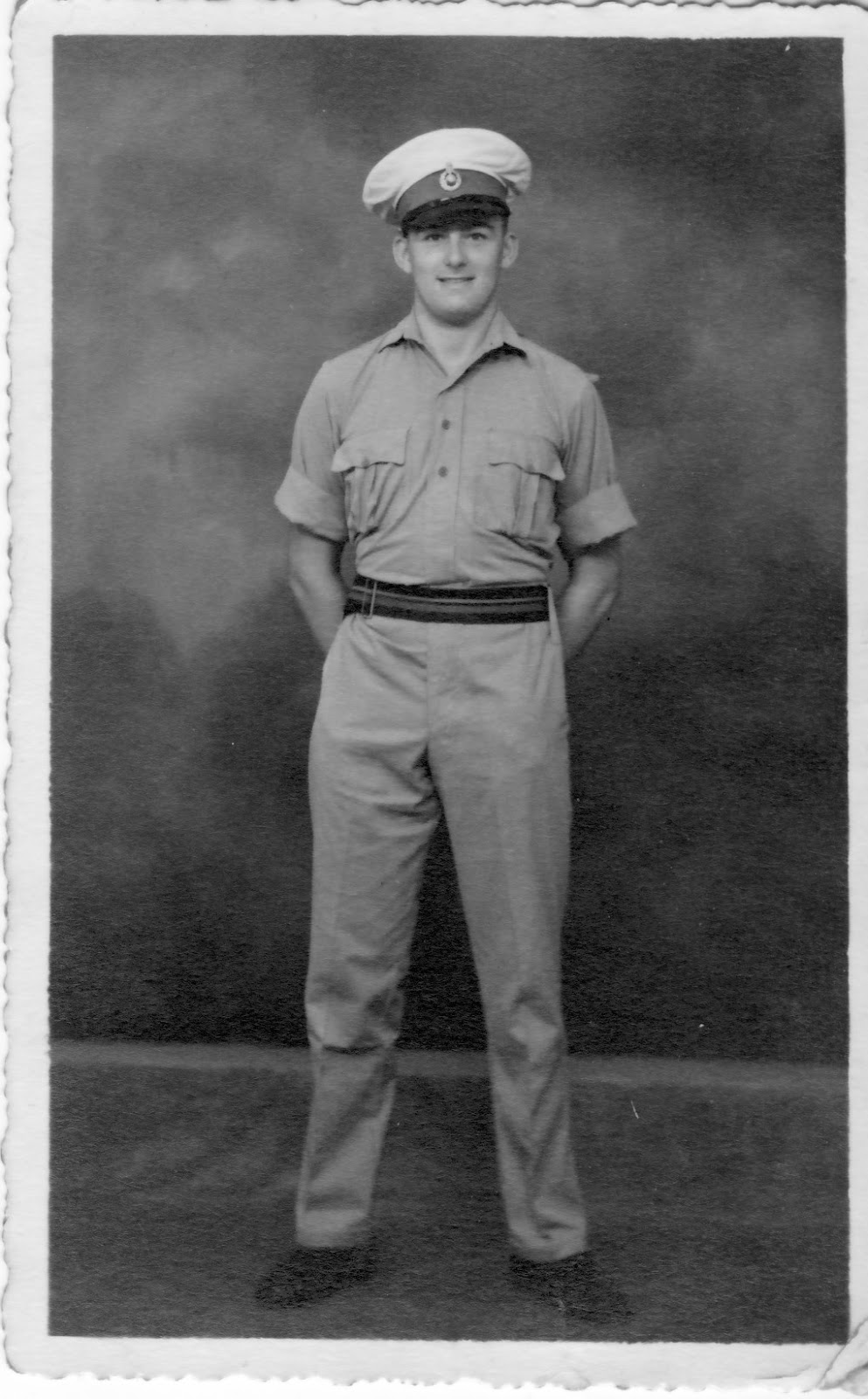
Joseph Roy Stracey
Joseph Roy Stracey 1922-1942
I've written quite a lot about my uncle Roy so please see my previous post for an account of his brief life and death. Roy was a royal marine serving on HMS Hermes when it was attacked and sunk by Japanese fighter planes on 22nd April 1942. He was only 19 when he died and his name is recorded on the Plymouth Naval Memorial.


At the going down of the sun and in the morning,
We will remember them.

Sunday, 12 August 2012

The Aunt I Never Knew

This is a blog post about asking the right questions. As a child I always knew my dad had a sister who had died long before I was born, but for years I knew almost nothing about her, she was just a name. It wasn't that Gladys was a black sheep in the family which meant she shouldn't be mentioned, it was more the case that my dad never spoke about any of his family. Or rather he never volunteered the information though he would happily talk about them if you asked. When I was young, and not interested in my ancestry, I didn't have the right questions in mind so never expanded my knowledge of what Gladys was like. It's only since I began investigating my family tree, using a combination of the available records, and pinning my father down to ask those all important questions, that I've managed to piece together Gladys' short life and put some flesh on the bones.

Gladys c.1920

Gladys was born on 14th July 1916 in East Finchley in North London, the first child of Joe and May Stracey. The world was embroiled in the Great War and so for the first few years of her life she would see little of her father who was away serving his country in Mesopotamia and India. For the duration of the war, Joe would carry a small photo of Gladys and her mother in his wallet.

Gladys and her mother - the photo
that Joe carried in his wallet
When she was six, Gladys was joined by a younger brother, Roy, and then ten years later my father completed the family. I know very little about her early years, however judging from the wonderful family photo albums that I have, it was a happy time, full of games, family occasions and childhood scraps.

From this point onward until her death, her life was a blank. I knew she had died at a fairly young age but my dad was not forthcoming with the cause. It was time to delve deeper and start asking questions.

So on a visit to my dad a couple of years ago, we were talking about family history and I casually asked him whether she had ever been married, expecting the answer to be in the negative as there had never been any mention of a husband or children. "Oh yes", replied my dad, "she married a POW". I was quite dumbfounded. After several years of researching my family tree and interrogating my father about his family and Gladys, he had never mentioned that his sister had been married. I don't blame him however, after all, I hadn't asked the pertinent question!

Samuel and Gladys McNairney
It turns out that Gladys had married a gentleman by the name of Samuel James Woods McNairney, in London, in 1951. He was, indeed, an ex-prisoner of war. Ancestry's British Army Prisoners of War dataset revealed that he had spent most of the war in a POW camp in Poland called Stalag XX-B. Further research on the internet explained how his battalion in the Royal Scots Fusiliers had been fighting a rearguard action during May 1940 to ensure the safe evacuation of troops at Dunkirk and that subsequently he had been captured. Gladys met him after the war when she was working as a cashier in a butcher's shop in Golders Green. My dad didn't particularly like him very much, describing him as "not a very nice man". That makes me feel quite sad as it has somewhat tainted my view of Samuel. I asked my father whether they had had children. I think I already knew the answer to that one, but it couldn't hurt to ask. "Oh no" replied my dad "she was much too old". She was 35 on her wedding day!

Gladys
Samuel wasn't Gladys' first love however. At some stage, most likely in the late 1930s, she met a young man called Donald Gabriel. He was a constable and they met one day on the East End Road in East Finchley. By all accounts he was her first serious relationship as they were engaged for a time. However, for reasons unknown, she broke off their engagement. Donald was a former pupil of the renowned Haberdasher Aske's Boys School in Hertfordshire and went on to join the army at the outbreak of the Second World War. Sadly he was not to survive. Dad thought he was in the Grenadier Guards and that he'd died in Burma but the only Donald Gabriel that I have found, via the Commonwealth War Graves Commission, is a Lieutenant in the Royal Indian Army Service Corp who died in 1943 and is buried in Baghdad. Donald and Gladys' relationship is the sort of information that would be almost impossible to find anywhere except through the recollections of a family member. Their romance would have been lost forever if my father had not recounted it to me.

But back to her marriage. Gladys and Samuel set up home in East Finchley just around the corner from the house in which she grew up. Sadly, however, they were only to be married for about eight years as in February 1959 Samuel died. Gladys moved back to live with her parents and brother although widowhood was to last just a few months. Later that same year, in early November, just months after the death of her husband, tragedy struck. Gladys had walked a fair distance from the local tube to her home and apparently walked into the house, sat at the kitchen table and had a massive heart attack. Her death certificate shows she had congestive heart disease and hypertension. But I was shocked when I noticed the date of her death. She had died on the 5th November on my father's 27th birthday.

Learning about Gladys has made me realise that it's the little details which can really make a person's history come to life. And these details so often come from a relative rather than an official document. They can also be found in newspapers, especially the splendidly written articles from the 19th century which never shied away from telling it how it was, full of juicy detail and commentary. But nothing beats the titbits you get from a relative as you then find out what they thought of the situation, or the person. That can only add flavour to an account of someone's life. So don't hesitate, quiz those relatives now, don't leave it until it's too late.

Gladys Stracey 1916-1959

Sunday, 29 April 2012

Dorothy Lucy Bagley 1895-1940 - A Widow's Story

A while ago I related the sad story of my great uncle, James Ivanhoe Cullip, who survived the Great War only to die one week after his wedding in 1918 from the Spanish Flu pandemic. I was intrigued as to what became of his widow, Dorothy.

One can only imagine the range of emotions that she must have endured at the time. From the elation of her wedding in the local parish church, where they lived in East Finchley, London, through the worry that she would have felt when her new husband fell ill, to the incredible shock when death took him from her, and the subsequent grief of widowhood.

But evidence shows that she did pull through this dreadful time, as three years later she was to remarry. Her new husband was Alfred Walter Chappell, and I was surprised to see that they were married in Sawbridgeworth in Hertfordshire. The reason for my surprise was that Sawbridgeworth was the village where my grandfather, Nathaniel Joe Stracey, came from. He had moved to London in the first decade of the twentieth century and in 1916 married my grandmother, Esther May Cullip, the sister of James Ivanhoe. The Cullips originally hailed from Tempsford in Bedfordshire; they had had no connection with Sawbridgeworth except through my grandfather. So to see the widow of my great uncle getting married in Sawbridgeworth immediately sparked my interest and a desire to know more.

My first port of call was the 1901 census for Sawbridgeworth. On running a search for Alfred Chappell I was amazed to see that he lived next door to my 9-year old grandfather, Nathaniel Joe, in Bell Street. Alfred was 5 years old. Were they childhood friends? My instincts tell me they were.

The 1901 Sawbridgeworth census showing my grandfather,
Joe Stracey, living next door to Alfred Chappell.

I don't know where Dorothy lived following the death of James Ivanhoe. She may have returned to her parent's home, a few streets away from her new relations, or she may have moved in to what should have been the marital home with her father and mother-in-law. In any case, in this close-knit community where everybody knew everyone else, and to some extent, was related to everyone else, there would have been much contact between Dorothy and her new family. I believe that after Nathaniel Joe returned home from the war he probably had a visit from his old friend Alfred Chappell and introductions were made. This was a new beginning for Dorothy as, on Christmas Eve 1921, she married Alfred and they went on to have three children together.

But this isn't the end of Dorothy's story. Whilst researching Dorothy's death date, I was shocked to discover that her death was registered in 1940, just nine years after the birth of her third child. Why had she died at such a relatively young age? After further investigation, I discovered that Dorothy was one of five people who had been killed on the night of 10th October 1940 as a result of 'enemy action'. It was the height of the Blitz, and with Sawbridgeworth being so close to London, it appeared that a German bomber had dropped its load on Sawbridgeworth resulting in the deaths of two women and three young children. Three houses in Cambridge Road, where Dorothy lived, were to take the full force of the blast. Dorothy, who lived at number 108, was killed, along with a 10 year old girl who was staying with her at the time. Two children in the next door house, number 110, were also killed, along with a mother from number 112 who died of wounds the following day. You can read a moving account of the incident here.

What a sad end for Dorothy. Her first husband had survived the First World War only to fall victim to the raging flu pandemic. Then, having made a new life for herself in rural Hertfordshire, Dorothy was to meet a sudden and devastating death as a direct result of a German bombing raid over England. She was only 44. Seventy years after the Second World War, the happenings of that time can seem very far removed. But as I discover more and more family members whose lives were impacted by the cataclysmic events of the twentieth century I realise just how many ordinary people, and members of my own family, were effected by world events. Dorothy is a case in point, and sadly she was one of the thousands of people for whom the war came to her with such dreadful consequences. She is remembered on the Sawbridgeworth War Memorial, alongside the other innocent victims of that bombing raid.

The Sawbridgeworth War Memorial showing the names of
the victims of the German bombing raid of 10 October 1940.

Monday, 9 April 2012

Joseph Roy Stracey 1922-1942 and HMS Hermes

Today, 9th April 2012, is the 70th anniversary of the sinking of HMS Hermes off the coast of Sri Lanka in the Second World War. On board was a 19-year old marine, my uncle, Joseph Roy Stracey. Tragically, he was one of the 307 men who was lost when the ship went down.

HMS Hermes
HMS Hermes was the world's first purpose built aircraft carrier, launched in 1919. By the Second World War she was considered to be an old vessel. Nevertheless, she had a distinguished wartime career hunting for German U-boats in the Atlantic and tracking down enemy shipping in the Indian Ocean as part of the Eastern Fleet. The Eastern Fleet was formed in 1941 following Japan's entry to the war the previous December. Japan had experienced a series of successes in the Far East and, with these successes, was winning domination over the Indian Ocean. As a result Britain's vital shipping routes - which she needed to supply India and Ceylon with troops to avert any future invasion by Japan - were under threat. The Eastern Fleet's aim was to regain control of the Indian Ocean, with the fleet temporarily based at Trincomalee on the island of Ceylon.

On 5th April 1942, Japan attacked the Ceylonese naval base at Colombo sinking several ships. Then, four days later on the 9th April, they turned their sights to Trincomalee. The ships which had been in harbour, including HMS Hermes, had received prior warning that there was going to be an attack so had sailed out into open waters. It was on their return to Trincomalee that they were spotted by Japanese reconnaissance aircraft and attacked by over 30 fighters. She received 40 direct hits and sank within ten minutes.

The HMS Hermes burns after being attacked by Japanese aircraft.
This photo was taken from a Japanese plane.
HMS Hermes sinking following her attack by 30 Japanese fighters.

My 19-year old uncle was one of the many who died on that day.  Born and bred in East Finchley, London, he had enlisted in the Royal Marines a month before his 18th birthday. He must have been so eager to join up. Did he feel patriotic? Was he craving adventure in a wider world? His service record states that prior to enlistment he had been a factory hand, so becoming a marine must have offered excitement, a chance to see the world as his father had done in the previous war. And of course, at that age, one feels immortal.

Roy had six months of training at the Royal Marines Depot at Deal in Kent before spending the next four months in Plymouth. Whilst training he was pronounced 'good' at swimming, and qualified in Parade, Tactical Training, Naval Gunnery, Small Arms, Anti-Gas and Seamanship. He became part of the Hermes crew in December 1940.

He was tall, a six-footer like his father, and good-looking. In November 1941, the Hermes underwent a two and a half month refit in Simonstown, South Africa. It was there that Roy met the woman that, according to my father, he became engaged to. Her name was Lorraine and, unfortunately, that's all we know about her. Nonetheless, the one photo we have of them together speaks volumes as it shows two people very much enamoured of each other. It was a romance that was not to end happily as, less than three months after they parted, Roy was dead.

Roy and Lorraine in South Africa
I often wonder whether his body was recovered and is one of the unknown sailors buried in Trincomalee Cemetery. Or was his body consigned to the deep? I will never know. Either way Roy is commemorated on Plymouth Naval Memorial. The family have visited on several occasions to pay our respects and find his name amongst the thousands of other members of the Royal Navy who have no known grave. For me, I'm incredibly sad that I have an uncle that I never had a chance to know but I keep the photo of him and Lorraine on display in my home to ensure I never forget him.

This blog is in memory of my Uncle Roy and the other 306 men who died with the HMS Hermes.

Marine Joseph Roy Stracey 1922-1942

Saturday, 31 March 2012

Nathaniel Joe Stracey 1891-1961 - A Life in Pictures

This is a photographic record of my grandfather's life.  I wish I had known him, but unfortunately he died a long time before I was born.  Photos are all I have to know him by, but I feel, judging by the photos I have, that I would have got on really well with him.

Nathaniel Joe Stracey was born in 1891 in the village of Sawbridgeworth in Hertfordshire, England, but had moved to East Finchley, north London by the time he was twenty.  There he married my grandmother, Esther May Cullip, and had three children.  An ordinary man, he lived through extraordinary times.  He served in World War One in Mesopotamia and India and lost his eldest son to the Second World War.  He first worked as a gardener and then became a postman.  He retired in 1957 when he received the Imperial Service Medal for 'long and meritorious service'.  Joe died in East Finchley in 1961, aged 70.

As a boy Joe was a member of the Boys Brigade, a UK wide
organisation founded in 1854.  Its aim was to promote "habits
of Obedience, Reverence, Discipline, Self-Respect and all that
tends towards a true Christian manliness"
. This is probably
the earliest photo of Joe, taken in the first decade of the 20th
century in Sawbridgeworth.

This is a teenage Joe, looking very smart and with a flower in his
 lapel.  He appears to be attending a wedding, although, as he got
married when he was 23, I don't believe this was taken at his own
marriage ceremony.  He looks far too young.

On the 1911 census, Joe was working as a gardener at a large house, the Grange,
in East Finchley.  But at the time of his marriage to Esther May he was working as a
gardener at Lambeth Palace, the London home of the Archbishops of Canterbury.
This photo could have been taken at either establishment.  But how smart they look
 - working men in overalls, yet wearing ties.

In December 1914 Joe married Esther May Cullip.  This is probably
their wedding portrait as Esther is displaying her wedding ring and
they are seated in the classic 'newly weds pose'.  By this time, Joe
was enlisted in the 5th Battalion of the East Kent Regiment, also
known as the Buffs.  He looks incredibly dashing...

With the Buffs, Joe traveled to Africa, India and Mesopotamia (modern day Iraq).
His diary, written in 1917, reveals the voyage he undertook, stopping at Freetown
 (Sierra  Leone), sailing past the Ascension Islands, landing in Cape Town, then Durban
 (South Africa) before finally disembarking in Bombay.  Their stay in India was short
however, as within three months they were in Mesopotamia, where Joe stayed until at
least 1919.  My grandfather is the tall chap in the back row with the moustache.  They
are all carrying, or wearing, pith helmets with sun protection.

A very relaxed Joe with puttees on his legs and his pith
helmet by his feet.  This photo was taken in either
Mesopotamia or India.

After Joe was demobbed he returned to East Finchley and his family.
His eldest child, Gladys, was born in 1916.  But it was not until 1922 that
his eldest son, Joseph Roy, was born, followed a few years later by my
dad.  This photo was taken in 1935 and shows Joe, Esther May, Roy and
my dad on the beach.  Joe is still wearing a tie!

In 1935 Joe became a postman, a job he held until his
retirement in 1957. Here he is standing proudly outside
his home in East Finchley, with Esther May in the
background, with his bike and postbag.

This photo was probably taken around 1940.  Although
their expressions are serious, it's a relaxed photo with
my dad resting his hand on his father's knee.

Happy and at ease in the late 1940s.

Joe died in 1961, aged 70.  He died in the house
he'd lived in for the last 40 years.  Esther May
followed him eight years later.